

In the U.S., few fields offer better career prospects than STEM (Science, Technology, Engineering, and Mathematics). With the rapid growth of the STEM industry, as projected by the U.S. Bureau of Labor Statistics, more students are pursuing these fields, drawn by the promise of strong career opportunities and high salaries.
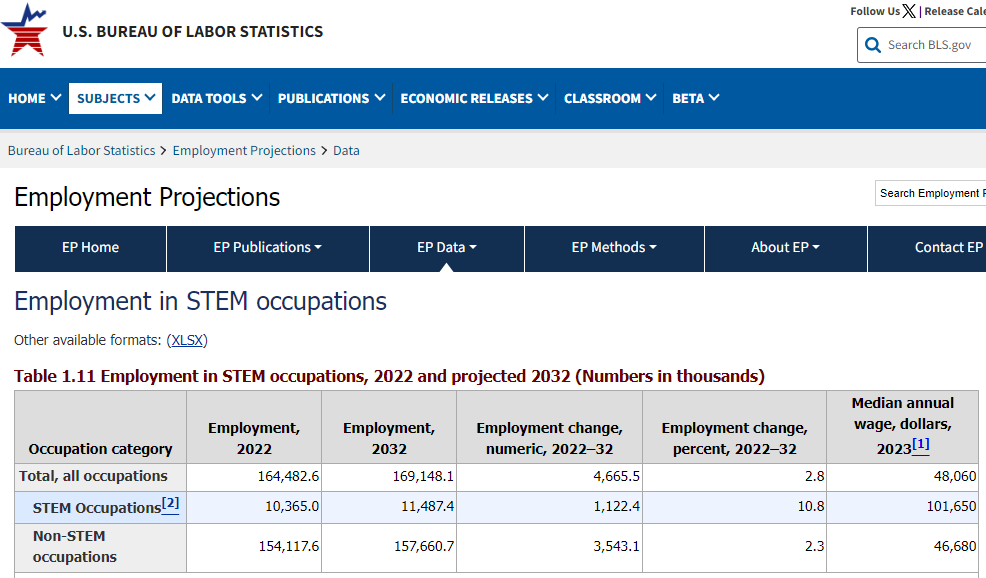
Every year, a large number of students pursue STEM-related fields. According to the U.S. Bureau of Labor Statistics, the STEM industry is expected to grow rapidly in the coming years. Data from PayScale also indicates that STEM fields offer the highest starting salaries and the best return on investment.
For students interested in STEM fields, Aralia is excited to share the 2026 Niche Best High Schools for STEM in America.
Niche Ranking Method
Niche’s rankings are based on an analysis of data from the U.S. Department of Education and information collected from millions of Niche users, including test scores, college data, and user ratings.
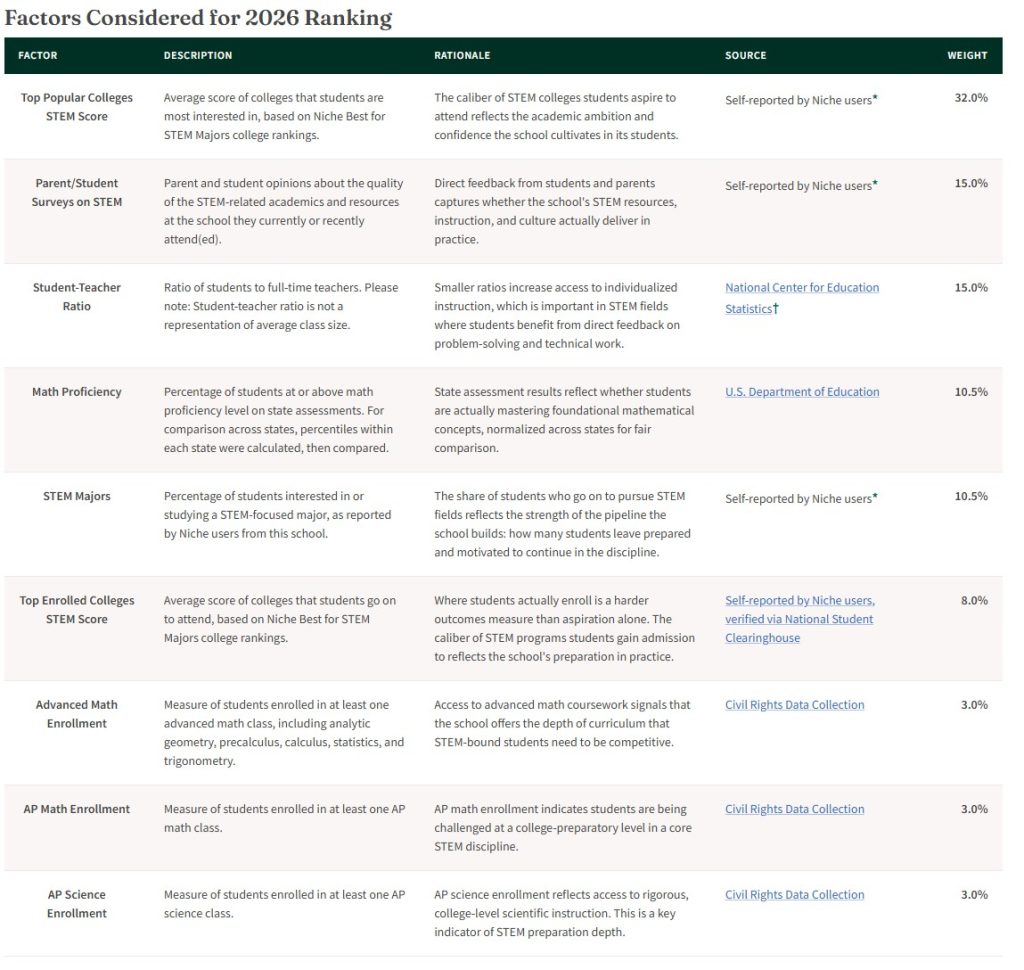
Niche’s primary factors include:
Prepare for American Computer Science League with Expert Coaching and Proven Results
What's New in the 2026 Rankings?
The 2026 rankings now place greater emphasis on verified college enrollment outcomes rather than student interest alone. A new Top Enrolled Colleges metric, based on National Student Clearinghouse data, complements the existing Top Popular Colleges factor, resulting in rankings that better reflect where graduates actually enroll after high school.
1. Top Popular Colleges STEM Score
This score reflects the average ranking of colleges that students are most interested in attending. The data comes from Niche’s rankings of the best colleges for STEM majors, giving insight into how well-prepared students are for top-tier STEM programs after high school. This accounts for 32% of the total score.
2. Parent/Student Surveys on STEM
This factor considers feedback from parents and students regarding the quality of STEM-related academics and resources at the school. These self-reported opinions from Niche users help gauge how well schools meet the needs of their STEM-focused students. This accounts for 15%.
3. Student-Teacher Ratio
This metric measures the number of students per full-time teacher, reflecting the level of individual attention students may receive. It is sourced from the National Center for Education Statistics, but it does not represent average class size. This accounts for 15%.
4. Math Proficiency
This percentage represents students who score at or above the proficiency level in math on state assessments. For cross-state comparisons, state percentiles are calculated and compared. The data comes from the U.S. Department of Education, providing a snapshot of students’ math skills. This accounts for 10.5%.
5. STEM Majors
This measures the percentage of students interested in or currently studying a STEM-related major, based on self-reported data from Niche users at the school. A higher percentage suggests a strong focus on and support for STEM disciplines. This accounts for 10.5%.
6. Top Enrolled Colleges STEM Score
This score reflects the average ranking of colleges that students are going to attend. The data comes from Niche’s rankings of the best colleges for STEM majors. This accounts for 8% of the total score.
7. Advanced Math Enrollment
This metric shows the number of students enrolled in at least one advanced math course, such as geometry, pre-calculus, calculus, statistics, or trigonometry. It reflects the school’s ability to offer rigorous math courses, with data from the Civil Rights Data Collection. This accounts for 3%.
8. AP Math Enrollment
The percentage of students enrolled in at least one AP math course is measured here, highlighting the school’s emphasis on college-level coursework in math. This data comes from the Civil Rights Data Collection. This accounts for 3%.
9. AP Science Enrollment
Similar to AP Math Enrollment, this metric tracks the percentage of students taking AP science courses, such as AP Biology or AP Physics, providing insight into the school’s preparation of students for college-level STEM education. This accounts for 3%.
Since private schools are not required to report data to the Department of Education, Niche also accepts data submitted directly by schools to ensure rankings are fair and accurate.
Below is a summary of the top 50 schools from the 2026 Niche Best STEM High Schools in America, including public and private institutions from various states:
Summary of the top 50 schools
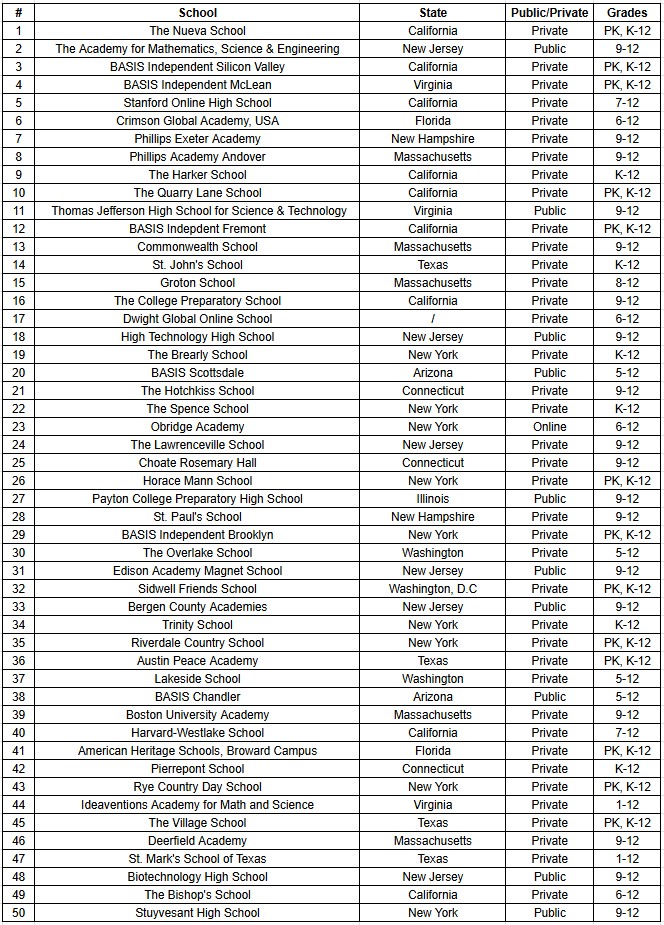
Of the top 10 schools:
- 4 are from California, including the top-ranked Nueva School.
- 2 are from New Jersey.
- 2 are from New England, with Phillips Exeter Academy ranked 4th and Phillips Academy Andover ranked 5th.
These schools share a strong emphasis on advanced STEM coursework, research opportunities, technology integration, and hands-on learning experiences. Many are located near major innovation hubs such as Silicon Valley and Boston, providing students with access to strong academic networks and industry connections. While some schools focus heavily on mathematics, science, and engineering pathways, others combine rigorous STEM education with broader liberal arts development, preparing students for competitive college admissions and future careers in science, technology, engineering, and mathematics.
Top 50 schools distribution:
- California has the largest representation, with more than 10 schools in the top 50
- The Northeast remains a major center for STEM education, with numerous highly ranked schools from Massachusetts, New Jersey, Connecticut, and New York, including elite boarding schools.
- Online and innovative education models are increasingly represented, with schools such as Stanford Online High School, Crimson Global Academy, Dwight Global Online School, and Obridge Academy, highlighting the growing demand for flexible, technology-enabled STEM learning.
We hope this overview provides a helpful starting point for understanding the top STEM high schools in the U.S. and the factors that contribute to their success. While rankings can offer valuable insights into a school’s academic strengths and STEM opportunities, they should not be the only factor when making such an important decision.
At Aralia, we encourage families to look beyond rankings and consider each student’s unique academic interests, learning style, extracurricular goals, and long-term aspirations when finding the right school fit. Thorough research, school visits, and a clear understanding of your child’s needs are essential steps in the school selection process.
For the full rankings and more information, please visit the Niche website.
Participate in American Computer Science League with Aralia Education
Aralia’s ACSL Preparation Program helps students strengthen their computer science fundamentals, master competition concepts, and develop the problem-solving skills needed to excel in the American Computer Science League. With guidance from experienced instructors and structured training, students can confidently prepare for every stage of the competition.
Aralia students have achieved outstanding results in academic competitions worldwide, including ACSL State Championships, Top 5% global rankings, and Gold Medal awards.

ACSL Competition Prep
The program begins with two weeks of dedicated programming practice to provide participants with an opportunity to enhance their skills. Subsequently, each of the 12 ACSL topics is allocated a two-week period, allowing ample time for in-depth exploration and understanding. Prior to each contest, participants are presented with two programming problems that are intentionally unrelated to the current topics. These problems are designed to enhance the coder’s skills and foster comfort in tackling diverse challenges.