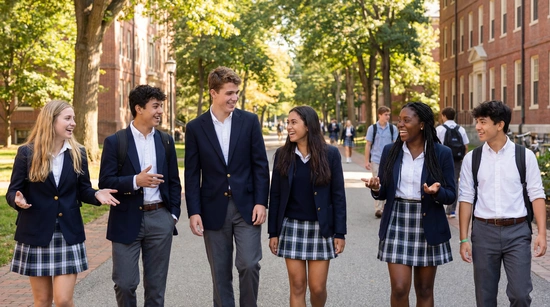


Boarding schools in the United States combine academics, residential life, and personal development, giving students a more immersive school experience both inside and outside the classroom. In this article, Aralia Education introduces the Top 50 boarding schools in the U.S. for 2026 based on Niche rankings, while also looking at key factors behind the rankings, such as college enrollment outcomes, the learning environment, school culture, and feedback from students and parents.
One of the biggest differences between boarding schools and traditional day schools is that learning does not end when classes are over. Dorm life, extracurricular activities, athletics, clubs, community events, and everyday interactions with teachers all become part of the student experience. For international students, especially those moving to the U.S. for the first time between the ages of 13 and 17, this type of environment can also make it easier to adjust to American classroom expectations, communication styles, and daily school life.
In this article, Aralia Education brings together the 50 highest-ranked schools on Niche’s 2026 Best Boarding High Schools list and highlights several important factors families should consider when choosing the right boarding school for their child.
1. What Is a Boarding School?
A boarding school is a private school where students can live on campus during the academic year. Unlike day schools, boarding school students typically live in school dormitories and receive support from the school in many aspects of daily life. They attend classes during the day, then take part in supervised study time, clubs, athletics, dorm activities, and weekend programs.
A typical U.S. boarding school experience includes three closely connected parts:
- Academics: Core courses, advanced classes, laboratory work, research opportunities, academic writing, and college preparation.
- Residential life: Dormitories, student supervision, study hours, meals, weekend activities, and community events.
- Personal development: Athletics, arts, clubs, community service, student leadership, and experiential learning opportunities.
Boarding schools can offer international students a wide range of opportunities, but the experience also requires a strong degree of independence and adaptability. Students need to adjust to living away from home, using English in everyday situations, managing their own academic and extracurricular schedules, and actively seeking support when they need it.
Build Critical Reading & Literary Analysis Skills for U.S. Boarding School
2. Overview of Niche’s Best Boarding High Schools Rankings
Niche is a U.S.-based platform that provides data, reviews, and rankings for schools and colleges across the country. For its 2026 Best Boarding High Schools rankings, Niche uses data from the U.S. Department of Education, college-related data, reviews from students and parents on Niche, and information submitted by schools.
One notable change to the 2026 methodology is that Niche no longer includes SAT and ACT scores in its rankings. More importantly, Niche introduced a new factor based on the colleges students actually enroll in after graduation, rather than relying only on the colleges students report being interested in. According to Niche, this enrollment data is verified through the National Student Clearinghouse, an organization that provides postsecondary enrollment and degree data in the United States.
Criteria Used in Niche’s 2026 Rankings
Criteria | Weight | What It Measures |
Four-Year College Enrollment Rate | 20,0% | Measures the percentage of graduating students who go on to attend a four-year college or university. |
Average Score of Colleges Students Are Interested In | 19,5% | Reflects the academic profile of the colleges and universities students are considering. |
Culture and Diversity | 15,8% | Considers racial and economic diversity, along with feedback from students and parents. |
Parent and Student Experience | 15,8% | Based on surveys and reviews about the overall student and family experience at the school. |
Student-Teacher Ratio | 15,8% | Provides an indication of access to teaching resources; it should not be interpreted as the same as average class size. |
Average Score of Colleges Students Actually Attend | 13,0% | Reflects students’ actual college enrollment outcomes after graduation. |
Source: Niche’s 2026 Best Boarding High Schools Ranking Methodology.
What Stands Out About This Ranking Methodology?
Looking at the criteria above, Niche evaluates more than traditional academic performance. About 20% of the ranking is based on the percentage of students who go on to attend four-year colleges and universities. At the same time, significant weight is given to school culture and diversity, student and parent experiences, and the student-teacher ratio. This broader approach is particularly relevant for boarding schools, where the quality of the student experience extends well beyond the classroom. A strong boarding school is shaped not only by its academic program, but also by the residential environment, community, support system, and day-to-day experience it provides for students.
3. Top 50 Boarding Schools in the US According to Niche
Niche’s 2026 Best Boarding High Schools ranking places The Hotchkiss School at No. 1, followed by Phillips Exeter Academy, Choate Rosemary Hall, The Lawrenceville School, and Groton School. Below is the full list of the Top 50 boarding schools in the United States according to Niche’s 2026 rankings.
Rank | School | State |
1 | The Hotchkiss School | Connecticut |
2 | Phillips Exeter Academy | New Hampshire |
3 | Choate Rosemary Hall | Connecticut |
4 | The Lawrenceville School | New Jersey |
5 | Groton School | Massachusetts |
6 | Phillips Academy Andover | Massachusetts |
7 | St. Paul’s School | New Hampshire |
8 | Noble and Greenough School | Massachusetts |
9 | Lake Forest Academy | Illinois |
10 | Cate School | California |
11 | St. Andrew’s School | Delaware |
12 | Oak Crest Academy-Pomona | California |
13 | The Loomis Chaffee School | Connecticut |
14 | The Peddie School | New Jersey |
15 | Deerfield Academy | Massachusetts |
16 | Milton Academy | Massachusetts |
17 | American Heritage Schools, Broward Campus | Florida |
18 | Elite Preparatory Academy | New Jersey |
19 | The Village School | Texas |
20 | Princeton International School of Math and Science | New Jersey |
21 | Concord Academy | Massachusetts |
22 | Veritas Collegiate Academy | Virginia |
23 | Middlesex School | Massachusetts |
24 | The Taft School | Connecticut |
25 | St. Mark’s School | Massachusetts |
26 | Mercersburg Academy | Pennsylvania |
27 | The Madeira School | Virginia |
28 | Blair Academy | New Jersey |
29 | Cranbrook Schools | Michigan |
30 | Sierra Canyon School | California |
31 | Washington Preparatory School | Washington |
32 | United World College-USA | New Mexico |
33 | The Hill School | Pennsylvania |
34 | St. Stephen’s Episcopal School | Texas |
35 | Indian Springs School | Alabama |
36 | American Heritage Schools, Palm Beach Campus | Florida |
37 | TMI Episcopal | Texas |
38 | Hackley School | New York |
39 | Belmont Hill School | Massachusetts |
40 | Georgetown Preparatory School | Maryland |
41 | Overlake Preparatory Academy* | Washington |
42 | The Thacher School | California |
43 | The Athenian School | California |
44 | The Stony Brook School | New York |
45 | Woodberry Forest School | Virginia |
46 | Miss Porter’s School | Connecticut |
47 | St. Albans School | Washington, D.C. |
48 | North Broward Preparatory School | Florida |
49 | The Frederick Gunn School | Connecticut |
50 | Pioneer Academy | New Jersey |
4. 10 Notable Top-Ranked Boarding Schools
#1 The Hotchkiss School – Connecticut
The Hotchkiss School ranks No. 1 on Niche’s 2026 Best Boarding High Schools list. Located in Lakeville, Connecticut, Hotchkiss is a boarding school serving students in grades 9 through 12. The school is known for its rigorous academic environment, close-knit residential community, and relatively small class sizes. It may be a strong option for families looking for a school that combines high academic expectations with an active and engaged campus community.
#2 Phillips Exeter Academy – New Hampshire
Phillips Exeter Academy is one of the oldest and most well-known college-preparatory schools in the United States. One of its defining features is the Harkness method, in which students sit around a large table and participate in discussion-based classes with their teachers and peers. This approach encourages students not only to absorb information, but also to explain their reasoning, ask questions, challenge ideas, and listen carefully to different perspectives.
#3 Choate Rosemary Hall – Connecticut
Choate Rosemary Hall is a coeducational boarding school in Wallingford, Connecticut. Its curriculum emphasizes a broad academic foundation while also giving students opportunities to explore individual interests through electives, the arts, athletics, and extracurricular activities.
Prepare for High School with Experienced Educators
#4 The Lawrenceville School – New Jersey
The Lawrenceville School is known for its discussion-based approach to learning and relatively small class settings. One of the school’s most distinctive features is its House System, which organizes students into smaller residential communities within the larger school. This structure gives students more opportunities to build close relationships with peers and adults on campus.
#5 Groton School – Massachusetts
Groton School is a boarding school in Massachusetts serving students in grades 8 through 12. With a relatively small student body, Groton places a strong emphasis on creating a close-knit residential community. Niche currently lists the school as having 379 students and a 4:1 student-teacher ratio.
Groton is also a good example of why families should look beyond rankings and consider the specific character of each school. A student who prefers a smaller, more personal environment with frequent interaction with teachers may have a very different experience from one who prefers a larger school with a broader range of programs and activities.
#6 Phillips Academy Andover – Massachusetts
Phillips Academy Andover is one of the oldest college-preparatory schools in the United States. Andover offers a broad curriculum with a wide range of courses and electives, allowing students to explore different academic interests before focusing more deeply on specific areas.
Andover is also known for its academically demanding environment. Students considering the school should not only have a strong academic record, but also be comfortable taking initiative, managing a challenging workload, and learning alongside highly motivated peers.
#7 St. Paul’s School – New Hampshire
St. Paul’s School is a coeducational boarding school in Concord, New Hampshire, ranked No. 7 on Niche’s 2026 list.
The school emphasizes a balance of academics, residential life, athletics, the arts, and personal development. This reflects a broader characteristic of many long-established U.S. boarding schools, where education is viewed as a full residential experience rather than something limited to classroom performance.
#8 Noble and Greenough School – Massachusetts
Noble and Greenough School, commonly known as Nobles, is a private school in Dedham, Massachusetts. One important point for families to note is that Nobles serves both day and boarding students. International families should therefore look carefully at the school’s residential policies, eligibility requirements, and the actual number of boarding spaces available.
#9 Lake Forest Academy – Illinois
Lake Forest Academy is located in Lake Forest, Illinois, near Chicago. For families interested in boarding schools outside the traditional New England region, Lake Forest Academy offers another geographic option to consider in the Midwest.
#10 Cate School – California
Cate School is a notable option for families interested in boarding schools on the West Coast rather than in New England, where many of the country’s best-known boarding schools are concentrated.
Learn more about well-known high schools in the United States.
How to Choose the Right Boarding School for Your Child
Step 1: Decide Whether Boarding School Is the Right Fit
Not every student is ready to live away from home starting in 8th, 9th, or 10th grade.
Families should consider questions such as:
- Can the student manage their time independently?
- Are they comfortable asking teachers for help when they do not understand something?
- Can they adjust to sharing a dorm and living closely with other students?
- Do they enjoy participating in group activities and school communities?
- Can they adapt to using English throughout the day?
- Are they mature enough to handle everyday challenges without immediately relying on their parents to step in?
Step 2: Consider School Size
Boarding schools in the United States vary significantly in size. Some enroll only a few hundred students, while others have much larger student bodies. Smaller schools may offer a more close-knit environment and more frequent interaction with teachers. Larger schools, on the other hand, may provide a wider selection of courses, athletic teams, clubs, and extracurricular opportunities. Students should think carefully about whether they would feel more comfortable in a smaller community or in a larger school with more options.
Step 3: Evaluate the Academic Fit
Students and families should look closely at the academic opportunities each school provides. Important questions include:
- What advanced courses are available?
- Does the school offer strong programs in areas such as science, mathematics, economics, history, or the arts?
- Are research opportunities available to high school students?
- How broad is the selection of electives?
- Can students personalize part of their academic program based on their interests?
- Does the school provide academic English support for international students?
If a student already has a strong interest in an area such as computer science, economics, engineering, the arts, or the social sciences, families should compare the actual course offerings and academic resources at each school rather than relying only on overall rankings.
Step 4: Understand Residential Life
Residential life is one of the most important parts of the boarding school experience, but it can sometimes receive less attention than academics during the school search. Families should ask:
- How many students typically share a dorm room?
- Who supervises and supports students in the dorms?
- How is evening study time structured?
- What do students typically do on weekends?
- Are there off-campus activities and trips?
- What support is available for international students during school breaks?
For international families, policies around longer school breaks can be especially important, since traveling home may involve significant distance, time, and expense.
Step 5: Evaluate Cost and Financial Aid
The cost of attending a U.S. boarding school is often significantly higher than that of many private day schools because tuition may also include housing, meals, and a range of on-campus services. However, the published tuition does not always reflect what a family will ultimately pay. Families should review the full cost of attendance, including: boarding fees, health insurance, books and technology, activity fees, additional or incidental costs, etc.
Some boarding schools have substantial financial resources and offer significant need-based financial aid. Families should therefore avoid assuming that highly ranked schools are only accessible to those who can afford the full published tuition.
Step 6: Review Admissions Requirements for International Students
Admissions requirements can vary considerably from one school to another, making this especially important for international applicants. Schools may consider a student’s GPA, entrance exams, English proficiency, recommendation letters, essays, interviews, extracurricular activities, and overall applicant profile. Some schools may require or recommend standardized tests such as the SSAT, while others may use different forms of assessment.
Choosing a boarding school in the United States is an important decision that can shape not only a student’s academic path, but also their personal growth and independence. Niche’s 2026 rankings can be a useful starting point for identifying well-known schools, but a higher ranking does not necessarily mean that a school will be the right fit for every student.
Rather than focusing only on reputation or ranking, families should take the time to look closely at each school’s academic programs, residential environment, support for international students, and opportunities for personal development. When students attend a school that aligns with their academic strengths, personality, interests, and long-term goals, they are more likely to make the most of the experience, build confidence, and prepare successfully for the next stage of their education.
Read More:
Finding the Right Fit with Aralia
Choosing between a boarding school and a day school isn’t just a decision about which school to attend; for parents, it’s a decision about how your child will live, grow, and experience their high school years. The right environment can make a tremendous difference: it will shape their academic growth, build formative life skills, and will set the foundation for a strong university application.
Start your journey with Aralia and discover what works best for you!