

As smartphone use among students continues to rise, concerns about distraction, academic performance, and mental health have led 36 U.S. states to limit or ban cellphone use in schools.
While policies vary by state, most target personal cellphone use during instructional time, not after school. Students can still use approved devices like laptops or tablets for learning, and schools typically provide procedures for emergency communication.
1. What Are the Main Reasons Behind Limiting Cellphone Usage?
Before the phone ban was implemented, most teachers in New York agreed that phones distracted students and inhibited creativity and learning. But on a larger scale, the use of cellphones in schools has long been a controversial issue, not only in the United States but also globally.
With the growing influence of social media, smartphones have become an inseparable part of modern life, especially among teenagers. But while these devices have made it easier to communicate, access information, and seek help in emergency situations, their unrestricted use of smartphones in American schools has raised serious concerns.
Not only does it impact academic performance, but it also affects the mental health of both teachers and students.
According to the 2023 Global Education Monitoring Report by UNESCO, excessive use of technology can negatively affect students’ academic performance. While digital tools have the potential to enhance learning, their overuse often leads to distraction, reduced concentration, and a decline in academic results. Experts also highlight that the use of social media and prolonged screen time has been associated with higher rates of anxiety and depression among the youth.
These findings underscore that while technology itself is not harmful, the way it is used matters greatly.
In response to these challenges, the U.S. Department of Education released Planning Together: A Playbook for Student Personal Device Policies, a resource to help schools, districts, and communities design effective cellphone policies by engaging educators, parents, and students in discussions about the role of personal devices in education.
Unlock Your Writing Potential: Students in Our Writing Competition Preparation Class Are More Likely to Secure Awards
2. States That Have Banned or Limited Cellphone Use

In November 2025, Wisconsin became the 36th state to limit cellphone and electronic device use in schools. This academic year alone, 17 states and the District of Columbia implemented new restrictions. The movement expanded rapidly since 2023, when the law was first passed in the state of Florida.
In 18 states and the District of Columbia, phones are completely banned during the school day. Some states, such as Georgia and Florida, enforce “bell-to-bell” bans for grades K–8. Another seven states allow limited use during lunch or between classes. States with local school governance structures may not impose statewide bans, but they may require schools to adopt their own cellphone policies.
As of November 2025, states with legislation or executive orders banning cellphone use in schools include: New Jersey, Alabama, Florida, Georgia, Indiana, Iowa, Kentucky, Louisiana, Nebraska, Nevada, New Hampshire, New York, North Carolina, North Dakota, Ohio, Oklahoma, Oregon, South Carolina, Tennessee, Texas, Utah, Vermont, Virginia, West Virginia, and Wisconsin, along with Washington, D.C.
Several other states require districts to adopt cellphone policies, including Alaska, Colorado, New Mexico, Maine, and Minnesota.
Additionally, Arkansas, Arizona, California, Connecticut, Idaho, Kansas, and Washington have laws that either limit or encourage schools to restrict cellphone use in classrooms.
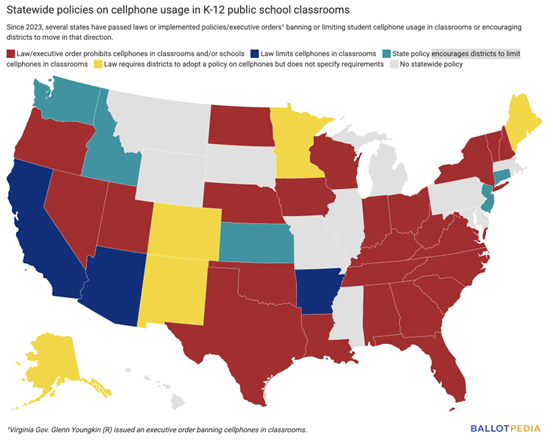
To learn more about each state’s specific regulations, refer to Ballotpedia’s report on State Policies on Cellphone Use in K–12 Public Schools.
3. What Does This Mean for Students?
Smartphones are more than communication tools. Whether it’s to record lectures to review later, take photos of notes, or use educational apps, these devices are important tools in the learning process of students. As such, a ban may initially seem inconvenient or restrictive.
However, students are not left without the necessary tools. They remain allowed to use other approved devices, such as laptops or tablets, provided that they are for academic purposes. These alternative devices can fully support students’ learning needs within a short adjustment period.
The restrictive policies are only applicable against personal cellphone use.
In most cases, phones are restricted only during study hours, not after school. Students can still contact family and friends outside of class time and many schools have also provided clear procedures for students who need to reach parents during emergencies.
Enhance Your Research Skills with Aralia’s Research Scholar Classes
4. Are There Any Alternatives to Banning Cell Phones in Schools?
Not all states enforce strict bans on cell phones in schools. Some, like Alaska and Colorado, require school districts to adopt policies but leave the specifics up to the discretion of individual districts and schools. Other states, such as California, only encourage schools to limit the use of personal electronic devices.
Strict bans can create tension between schools and students, and may worry parents whose concern is to contact their children in emergencies. In such cases, restrictions rather than outright bans can serve as a viable alternative, giving students and parents the balance of access to speedy communication and limited screen time.
Historically, it has been found that 91 percent of American schools prohibited nonacademic cell phone use during the 2009–10 school year, but as educational apps became more widely available, more schools gradually relaxed their restrictions on technology. Recognizing the pros and cons that gadgets bring, The Technology in Education Report in 2023 highlights that technology can enhance learning in certain contexts, but overuse or misuse can have negative effects.
A nuanced perspective is key, whether it’s in the form of policy or in the exercise of discretion with the use of technology. To educate students on responsible phone use, highlighting the importance of balance, not extremes, would better support their growth as future-ready professionals. Where technology is an integral part of daily life, the role of parents and learning institutions is not to shield the youth from it entirely, but rather to demonstrate that it can still be safely navigated despite its inherent risks and opportunities.
5. How to Adapt to This Change

Adapting to a phone ban can be challenging, especially in today’s technology-driven world, where the youth are more accustomed to constant connectivity. However, this recalibration can also be an opportunity to refocus on meaningful human connections and healthier study habits.
Reasonable smartphone restrictions are not meant to punish students, they are designed to create learning environments that promote concentration, engagement, and emotional well-being.
And when maintained, students may also come to appreciate its benefits when they reap outcomes such as better focus in class, stronger friendships, and more active participation in school life.
Adapting new habits need not be sudden. To adjust effectively, students can:
- Limit their daily screen time outside school hours.
- Practice short, focused study sessions without distractions.
- Ask parents to minimize contact during school hours.
- Stay informed about their school’s cellphone policy.
- Prepare traditional learning tools such as notebooks, planners, or printed materials.
The cellphone ban in U.S. schools is a significant step towards balancing technology’s benefits and challenges. But an application of these policies, without the public’s understanding of what it aspires to achieve, is only half the mission fulfilled. By grasping the reasoning behind these policies and by adapting them proactively, students are empowered to build better habits that support not just their academic success but also their overall well-being.