

In 2025, international student enrollment in the U.S. showed mixed signals. While total enrollment rose to about 1.18 million students, new international enrollments declined, especially at the graduate level. Visa disruptions, funding cuts, renewed testing requirements, and concerns about an unwelcoming political climate contributed to fewer new students, with notable drops from major sending countries such as India and China.
Looking ahead to 2026, signs point to a rebound. Deferred enrollments, more stable visa processing, and stronger international recruitment efforts suggest renewed growth. U.S. universities continue to prioritize global talent, expand outreach to emerging markets, and rely on international students for academic, cultural, and financial strength, making early preparation and strategic planning increasingly important.
This article provides a comprehensive overview of statistics regarding international student enrollment in the U.S. in 2025. Below, we analyze the underlying reasons behind recent changes and offer insights into what both aspiring students and parents can expect in 2026. Our aim is to help families make informed decisions while showing that opportunities for international students in the U.S. remain bright in 2026.
1. International Student Enrollment Decline Trend in the U.S. in 2025
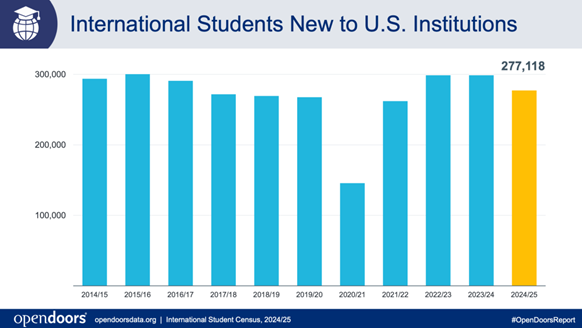
However, a closer look at the numbers reveals a more nuanced reality. While total enrollment increased, the influx of foreign students entering U.S. institutions declined sharply. In the 2024-2025 academic year, only 277,118 new international students enrolled, a 7.2% decrease from 298,705, which was recorded in 2023-2024.
The downward trend became more pronounced in fall 2025. U.S. colleges and universities reported a 1.4% overall drop in enrollment of foreign students, including both students enrolled in coursework and those participating in Optional Practical Training (OPT). Although seemingly modest, this significantly marked the first decline after four consecutive years of growth since the COVID-19 pandemic.
In actual numbers, the total of international students across the U.S. decreased by approximately 5,000, with the decline most visible in graduate programs. Enrollment changes by academic level included:
- Graduate students: down by 12% among reporting institutions
- New international students: dropped by 17%, indicating fewer students began their studies in the U.S. for the first time.
Improve Your Grades Within One Semester
2. 4 Reasons Behind the Downward Trend
Visa Application Challenges and Policy Disruptions
This came after the current administration ordered a pause on visa appointments last spring, causing disruption for prospective students. Evidently, in fall 2025, 96% of institutions cited visa-related issues as a major contributor to the decline in international enrollment.
According to IIE, institutions reported multiple challenges affecting students’ ability to secure visas in time for enrollment:
- Long visa appointment waiting times (96% of institutions)
- Temporary pause in visa issuance between May 27 and June 18, 2025 (81% of institutions)
- Travel restrictions that affected the arrival of newly enrolled international students in the past terms (68% of institutions)
As a result of these impediments, universities adopted flexible enrollment strategies. Nearly 72% offered deferrals to admitted international students to Spring 2026, and 56% extended deferral options to Fall 2026. Furthermore, 37% of institutions introduced flexible enrollment options, such as allowing students to begin their studies online or delay their start dates.
Government Funding Cuts and Financial Pressures
U.S. colleges and universities continue to face financial strain due to reductions in government funding. In 2025, the U.S. president ordered federal funding cut or frozen for numerous universities, including Harvard, Cornell, Duke, Princeton, among others. As public funding declines, many institutions have become increasingly reliant on international students, who typically pay higher tuition than homegrown students. While this has intensified recruitment efforts, funding uncertainty has also limited institutional capacity to provide comprehensive support services, further contributing to the decline in enrollment.
85% of Aralia Students Place in Top Writing Competitions
Policy Uncertainty and Perceptions of an Unwelcoming Environment
Beyond logistical barriers, broader political and social events in the past year played a significant role:
- 67% of institutions reported that student concerns about feeling unwelcome in the United States negatively affected enrollment
- 64% of institutions cited worries about the broader sociopolitical climate that promotes violence and discrimination against other ethnicities
A major turning point occurred on May 2025, when the Trump administration barred Harvard from enrolling international students for the 2025–2026 academic year and required current international students to transfer or risk losing legal status. We have also witnessed the Department of State boast visa revocation for 8,000 international students in an effort to “keep America safe.” High-profile actions such as this, along with reports of deportations and intensified visa reviews, reinforced perceptions of instability and harm among prospective international students.
The Return of Standardized Testing Requirements
After several years of adopting “test-optional” policies, many U.S. universities started reinstating college entrance exams like SAT or ACT beginning in the 2024–2025 admissions cycle. This shift created additional barriers for international students who had not prepared to take standardized tests or lacked access to testing resources.
This trend is expected to continue in the years to come, which could potentially put students from education systems with limited SAT/ACT support at a disadvantage. For aspiring international applicants, this new requirement underscores the growing importance of early academic planning and strategic preparation.
3. Countries with the Highest Number of Students in the U.S.
Concerns brought about by the U.S. student visa process emerged as the single most significant factor contributing to enrollment declines. This came after the current administration ordered a pause on visa appointments last spring, causing disruption for prospective students. Evidently, in fall 2025, 96% of institutions cited visa-related issues as a major contributor to reduced international enrollment.
According to IIE, institutions reported multiple challenges affecting students’ ability to secure visas in time for enrollment:
- Long visa appointment waiting times (96% of institutions)
- Temporary pause in visa issuance between May 27 and June 18, 2025 (81% of institutions)
- S. travel restrictions that affect the arrival of newly enrolled international students in the past terms (68% of institutions)
As a result of these impediments, universities adopted flexible enrollment strategies. Nearly 72% offered deferrals to admitted international students to Spring 2026, and 56% extended deferral options to Fall 2026. Furthermore, 37% of institutions introduced flexible enrollment options, such as allowing students to begin their studies online or delay their start dates.
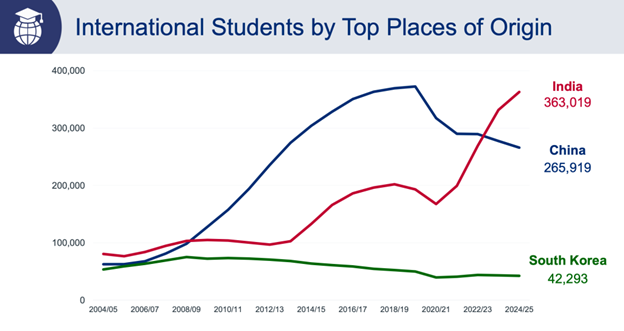
International students across the United States come from over 200 countries and territories. Among nearly 1.2 million foreign students, India, China, and South Korea are the top three sending countries, collectively making up more than half of the total international student population. These countries are followed by Canada, Vietnam, and Nepal.
In terms of enrollment stability, students from the United Kingdom, Canada, and Mexico showed the most consistent numbers. These countries typically have stronger access to financial resources, established pathways to U.S. colleges, and well-supported education systems, which help maintain steady enrollment.
In contrast, India, which saw rapid post-pandemic growth, witnessed notable declines in new enrollments in 2025. Only 39% of institutions reported stable or increased new enrollments from this country, suggesting that declines from this key market significantly influenced the national downturn.
4. Institutions with the Highest Number of International Students
The top 10 institutions with the largest numbers of international students in 2025:
- New York University – New York, NY: 27,532
- Northeastern University – Boston, MA: 22,465
- Columbia University – New York, NY: 20,733
- Arizona State University (Campus Immersion) – Tempe, AZ: 20,368
- University of Southern California – Los Angeles, CA: 17,884
- University of Illinois Urbana-Champaign – Champaign, IL: 16,144
- University of North Texas – Denton, TX: 12,982
- Purdue University – West Lafayette, IN: 12,874
- Boston University – Boston, MA: 12,845
- University of California, Berkeley – Berkeley, CA: 12,020
These institutions consistently highlight that large research universities and urban campuses continue to attract substantial international populations, mostly due to their strong academic reputations, significant global networks, and wide career opportunities.
5. International Students in the U.S.: Predictions for 2026
International Students and Enrollment Drivers in U.S. Higher Education
International students are central to the mission and long-term sustainability of U.S. higher education institutions, as they contribute significantly to academic excellence, cultural diversity, and financial stability.
More than half of institutions (56%) and nearly 7 in 10 large doctoral universities (68%) identify recruiting global talent as a core institutional priority. This reflects the academic and cultural contributions international students bring to the campus, enriching dialogue and strengthening global perspectives, which 81% of educational institutions place great importance on.
Outside the classroom, financial considerations further reinforce their importance. Because international students typically pay higher tuition than domestic students, they help stabilize university budgets and sustain academic programs. At the same time, global competition for international students continues to intensify, as countries such as China have expanded national policies, research infrastructure, and funding incentives to attract and retain top global talent.
Their impact also extends well beyond academics: in 2024, international students contributed nearly $55 billion to the U.S. economy and supported more than 355,000 jobs, according to NAFSA and JB International.
Together, these academic, economic, and competitive gains that international students bring have driven U.S. colleges and universities to significantly refine their recruitment strategies. 71% percent of institutions report that active international recruitment efforts are a primary driver of enrollment growth. To remain competitive, institutions are investing more heavily in personalized outreach, virtual recruitment events, alumni engagement, and partnerships with international education organizations that improve yield and attract gifted students from all over the world. UC Berkeley provides a clear example: amid state funding cuts, the university was able to reach a 29% increase in new international student enrollment in 2025, deliberately enrolling more non-resident students to offset budget pressures.
Increase in New Enrollment
Despite the decline in 2025, various indicators suggest that new international student enrollment is likely to bounce back in 2026. With 72% of institutions offering deferrals to Spring 2026, a substantial portion of delayed demand is expected to convert into actual enrollment.
On the bright side, many students who were unable to begin their studies in Fall 2025 did not withdraw their applications or change destination countries; they only postponed enrollment due to visa delays or logistical challenges. Now that updated student visa policies have been in effect, visa issuance has returned to stability, and both applicants and institutions are now gaining clearer expectations regarding timelines and procedures.
International Student Outreach and Recruitment as Top Priority
U.S. institutions are responding to the recent volatility by placing even greater emphasis on international recruitment. Some of the planned adjustments for the 2026-2027 academic year are:
- Prioritization of international student outreach and recruitment for 84% of surveyed institutions. Within this group, 27% classify it as a high priority.
- Strengthening partnerships with recruitment agents, as more institutions are working with education agents around the world to broaden reach and convert more inquiries into actual applications.
These strategies demonstrate that international students remain central to institutional planning and enrollment strategies. In practice, this prioritization is expected to translate into expanded recruitment budgets, deeper engagement with key sending markets, increased collaboration with global partners, and more robust post-admission support. For prospective students, this environment creates both opportunity and competition, as universities actively seek to attract the most qualified applicants from around the world.
Targeted Recruitment Markets
Undergraduate Recruitment
Undergraduate students account for 30% of international students in the US. Starting Fall 2025, U.S. colleges and universities continued to prioritize undergraduate international recruitment, with a clear focus on market diversification. This means institutions are expanding outreach beyond traditional sending countries such as China, India, and South Korea, targeting emerging markets in Asia, Africa, and Latin America. Broadening their base ensures enrollment stability and wider cultural perspective.
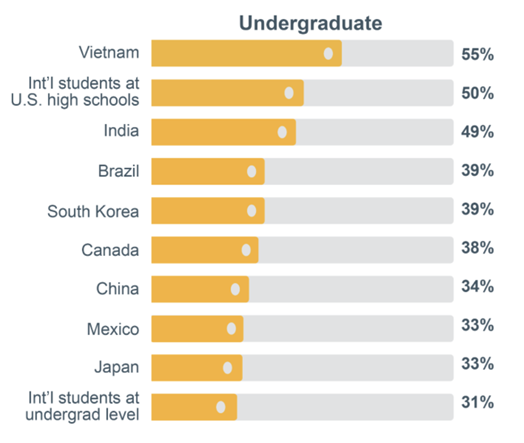
In fall 2025, various colleges and universities were seen to prioritize undergraduate recruitment efforts in several key markets, with Vietnam (55%) leading the list. Other priority countries included India (49%), Brazil (39%), South Korea (39%), Canada (38%), and China (34%).
The placement of China in sixth position is particularly notable. As the largest historical source of international undergraduates, China’s lower ranking suggests that most institutions are actively seeking to diversify their undergraduate recruitment strategies. Vietnam’s prominence on this list highlights the nation’s growing importance as a stable, high-potential undergraduate market, driven by strong academic drive and preparation, rising middle-class investment in education, and sustained interest in U.S. degrees.
Graduate Recruitment:
With a 2.7% decline in international graduate enrollment in the U.S., universities and colleges are expected to intensify their focus on foreign graduate student recruitment in the upcoming admission cycle. This priority is driven by the fact that international graduate students account for more than 40% of the total international student population in the country, making them critical to maintaining enrollment stability and supporting the long-term sustainability of their respective institutions.
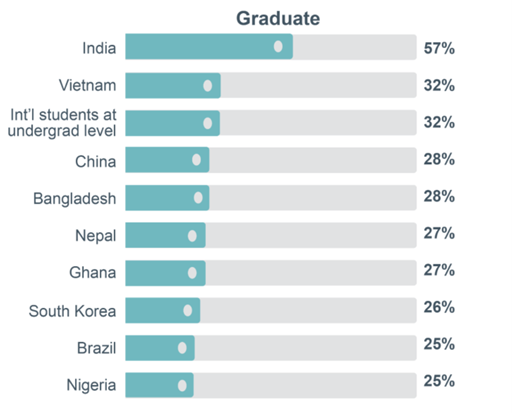
Graduate recruitment remains highly concentrated, with India continuing to dominate institutional focus. 57% of institutions prioritize India for graduate student recruitment, far exceeding recruitment efforts in any other country. This trend most likely stems from India’s large pool of highly qualified graduate applicants and the country’s well-established STEM culture and international education, which aligns closely with most of U.S. graduate programs. Despite recent enrollment declines among Indian graduate students, institutions’ continued focus on India reflects confidence in the long-term depth and quality of this talent pipeline.
Beyond India, students from Vietnam, China, Bangladesh, Nepal, Ghana, and South Korea are also key graduate recruitment markets, with more than a quarter of institutions actively conducting outreach in each of these countries. Vietnam represents a particularly important emerging market at the graduate level. Historically, Vietnamese students in the U.S. have been predominantly undergraduates. However, with 16% overall growth and an 11% increase in graduate enrollment in 2024-2025, we can now see a trend of institutions’ increasing commitment to expanding Vietnam’s presence in graduate programs.
Students from China continue to make up a substantial share of the graduate population, accounting for approximately a quarter of all international graduate students. As a result, 28% of U.S. universities continue to place China in their graduate recruitment priority.
Unlock Your Writing Potential: Students in Our Writing Competition Preparation Class Are More Likely to Secure Awards
Overall, the international student landscape in the United States in 2025 reflects a period of transition. While enrollment data reveal short-term disruptions, particularly in new student enrollments, the underlying demand for U.S. higher education remains strong.
Looking ahead to 2026, signs of recovery are already emerging. Deferred enrollments, more stable visa processes, and intensified institutional recruitment efforts point toward renewed growth, especially for students with early preparation and strategic application. At the same time, universities are becoming more selective and more intentional in their foreign student recruitment, placing greater emphasis on specific markets, academic preparedness, and alignment with program goals.
For prospective international students and families, this evolving environment gives hope towards an important reality: U.S. higher education remains committed to welcoming global talent and providing abundant academic and career opportunities to international students.
This trend also highlights that success in U.S. admissions is no longer defined solely by academic performance. It requires timely planning and informed decision-making at every stage, from school selection and test preparation strategy to visa preparation and enrollment timeline.
Read more:
Get into Your Dream School in the US with Aralia’s Support
To build an application that impresses top universities, students need more than just good grades. They must present compelling personal essays, outstanding extracurricular activities such as international competition awards, and research experience in high school.
To help students succeed with international college admissions, Aralia has designed top-tier programs led by professors and instructors from leading universities and high schools. These instructors have guided Aralia students to achieve numerous prestigious international awards, craft compelling personal essays, and complete scientific research published in leading international journals.
Book a consultation with Aralia today to receive personalized guidance on your college journey!