

People often use business and entrepreneurship interchangeably in casual conversations. At the undergraduate level, entrepreneurship is frequently integrated seamlessly into the broader Business Management major. However, these are distinct academic disciplines with different knowledge bases and skill sets, which is why they often separate into two specialized programs at the master’s level, such as an MBA versus a Master in Entrepreneurship and Innovation. This article explores the core differences between these two fields, which may help you choose the academic path for your upcoming college journey.
1. Business Degree
A business degree gives students a broad understanding of how organizations operate, make decisions, manage resources, and grow in competitive markets. For high school students considering college majors, business can be a strong option because it introduces several core areas of the corporate world rather than focusing on just one specialized field.
Students typically study subjects such as accounting, finance, marketing, management, organizational behavior, operations, and business communication. Together, these courses help students understand how different parts of a company work together, from managing finances and employees to developing products, reaching customers, and making strategic decisions.
For example, undergraduate business students at UC Berkeley Haas take courses across major areas of business, including:
- Accounting
- Finance
- Marketing
- Business Communication
- Organizational Behavior
A traditional business education also develops a structured and analytical way of thinking. Students learn how to evaluate an organization’s performance, identify problems, interpret data, manage risk, and make decisions that can improve efficiency and long-term growth.
Because of its broad curriculum, a business degree can prepare students for a wide range of career paths, including finance, consulting, marketing, management, operations, and human resources. It can be especially suitable for students who are interested in understanding how established organizations function and how strategic decisions influence their performance.
85% of Aralia Students Place in Top Writing Competitions
2. Entrepreneurship Degree
An entrepreneurship degree focuses on how new ideas are turned into viable businesses. Students learn how to identify market opportunities, develop products or services, test business ideas, attract funding, and manage the uncertainty that comes with building a new venture.
Some universities offer entrepreneurship as a standalone major, while others include it as a concentration within a broader business or management degree. Compared with a traditional business curriculum, entrepreneurship programs usually place greater emphasis on innovation, experimentation, and venture creation.
For example, Babson College offers an Entrepreneurship concentration built around experiential learning. Students can take courses such as:
- New Venture Creation: Starting the Right Business for You: Students learn how to evaluate a business idea, assess market demand, explore product-market fit, and determine whether a venture is worth pursuing.
- New Technology Ventures: This interdisciplinary course introduces students to the process of developing technology-based businesses, including market research, intellectual property, funding, and business planning.
- Accelerate Your Venture: Growth in Motion: Designed for student founders who already have a venture and want to explore strategies for growth.
- Launch Your Venture: Students move from planning to execution by testing assumptions, conducting market research, and working through practical decisions related to marketing, finance, and operations.
Entrepreneurship students also develop skills that are especially useful in early-stage ventures. These may include pitching ideas, testing prototypes, working with limited resources, adapting quickly to customer feedback, and revising a business model when initial assumptions do not work.
While traditional business programs often focus on understanding and improving established organizations, entrepreneurship programs tend to emphasize building something new under uncertain conditions. Students are encouraged to experiment, take calculated risks, learn from setbacks, and make decisions even when complete information is not available.
For students who enjoy creating new ideas, solving open-ended problems, and working in fast-changing environments, entrepreneurship can provide a highly practical and creative academic path.
3. Business vs Entrepreneurship: What is the Difference?
For high school students and parents, the biggest difference lies in what each field emphasizes. Business programs usually provide a broad foundation in how organizations operate, while entrepreneurship programs focus more specifically on creating and developing new ventures.
| Comparison Factor | Business Major | Entrepreneurship Major |
| Overall field of study | Understanding, managing, and improving organizations across different industries. | Identifying opportunities, developing new ideas, and building or growing new ventures. |
| Learning objectives | Learn how major business functions work together and how organizations make strategic, financial, and operational decisions. | Learn how to recognize market needs, test ideas, develop business models, attract resources, and navigate uncertainty. |
| Core knowledge | Accounting, finance, marketing, management, organizational behavior, operations, and supply chain management. | Venture finance, innovation, design thinking, product development, market validation, pitching, and startup strategy. |
| Career prospects | Financial Analyst, Marketing Manager, Management Consultant, Investment Banker, Operations Manager, Corporate Strategist, and more. | Startup Founder, Product Manager, Business Development Specialist, Innovation Consultant, Venture Capital Analyst, and more. |
| Core skills | Data analysis, strategic planning, communication, financial decision-making, team management, and problem-solving. | Creative problem-solving, adaptability, opportunity recognition, experimentation, pitching, resourcefulness, and resilience. |
4. What Should You Study?
A Business Major may be a good fit if you:
- Prefer structured environments with clearly defined roles and responsibilities.
- Enjoy improving existing systems, processes, and organizations.
- Are interested in areas such as finance, consulting, marketing, management, or operations.
- Like making decisions based on data, established frameworks, and long-term planning.
- See yourself building a career within an established company or organization.
For example, you may be interested in working in consulting, finance, technology, or corporate management and gradually taking on greater responsibility over time.
An Entrepreneurship Major may be a good fit if you:
- Enjoy identifying problems and developing new solutions.
- Are comfortable working in uncertain or fast-changing environments.
- Prefer building new products, services, or organizations rather than working only within existing systems.
- Like wearing multiple hats and learning across different areas of business.
- Are interested in careers related to startups, innovation, venture capital, or business development.
Entrepreneurship may be especially appealing if you enjoy experimenting, testing ideas, and learning through trial and error.
5. How Can High School Students Find the Right Major?
- 7 High School Entrepreneurship Competitions in 2025-2026
- 8 Business Competitions for High School Students
6. Harvard International Review Academic Writing Contest
Unlike competitions that focus exclusively on economics, the Harvard International Review Academic Writing Contest (HIR Academic Writing Contest) encourages students to explore global issues through an interdisciplinary lens. The competition is open to students in Grades 7–12 worldwide, with students in Grades 7–8 competing in the Junior category.
Students who choose economics-related topics can combine economic concepts with fields such as politics, technology, international relations, or public policy to develop a research-based essay. This interdisciplinary approach allows participants to examine complex global challenges from multiple perspectives.
A unique feature of the competition is the HIR Defense Day. Finalists are invited to defend their research virtually before a panel of judges through a presentation and an academic Q&A session lasting approximately 15 minutes. This final round helps students further develop essential skills in presenting research, defending their arguments, and responding to academic questions.
2026 Competition Timeline
Season | Submission Deadline | Defense Day |
Spring | 31/05/2026 | 29/06/2026 |
Summer | 31/08/2026 | 05/10/2026 |
Fall/Winter | 02/01/2027 | 05/02/2027 |
Website: https://hir.harvard.edu/contest/
Aralia Students Are 4x More Likely to Publish a Research Paper
Which Competition Is Right for You?
When choosing an economics essay competition, students should not focus solely on the reputation of the organizing institution. Instead, they should consider their academic goals, current skill level, and preparation experience.
Some key factors to consider include:
- Background in Economics: Students should evaluate their current understanding of economics before choosing a competition. Those who have not studied AP, IB, or A-Level Economics may want to begin with competitions that feature broader topics and require a more accessible level of research, such as the LSESU Economics Society Essay Competition.
- Research Skills: Competitions such as HIEEC and the John Locke Essay Competition require students to independently find, evaluate, and cite reliable academic sources. Strong submissions typically demonstrate the ability to analyze evidence, incorporate research, and develop well-supported arguments.
- Academic Writing Ability: Most essay competitions require students to write using an academic style, with clear arguments, logical structure, and proper citations. Students should be comfortable expressing complex ideas and supporting their viewpoints through evidence.
- Preparation Time: A high-quality essay often requires several weeks or even months of preparation. Students need sufficient time to research background materials, develop their arguments, create an outline, write multiple drafts, revise, and polish the final submission.
Below is a reference table comparing the academic difficulty and competitiveness of each competition to help students make a more informed choice:
Level | Suitable for |
Beginner | LSESU Economics Society Essay Competition Harvard International Review Academic Writing Contest |
Intermediate | Scholar of Tomorrow Essay Competition |
Advanced | Harvard Undergraduate Economics Association High School International Economics Essay Competition (HIEEC) Marshall Society Essay Competition |
Highly Competitive | John Locke Essay Competition (Economics) |
Participating in a competition that matches your current abilities and dedicating sufficient time to preparation will bring greater value than entering multiple competitions without the time to develop strong submissions. Before choosing a competition, students should carefully review the essay prompts and requirements to determine whether the topics align with their academic background, interests, and level of expertise.
International economics essay competitions are not only opportunities for students to demonstrate their knowledge but also valuable platforms for developing essential skills for university, including research, critical thinking, data analysis, and academic writing. More importantly, the preparation process often provides lasting benefits beyond the final award. By reading academic literature, analyzing contemporary economic issues, and building evidence-based arguments, students develop the intellectual foundation needed to succeed in an international university environment.
Prepare for Economics Essay Competitions with University Professors
Aralia’s international essay competition preparation programs are led by professors and instructors from top universities and boarding schools. With expertise in economics and academic research, these instructors help students deepen their understanding of economic concepts, learn effective research methodologies, identify high-quality academic resources, and craft compelling essays that improve their chances of success in prestigious competitions.
Aralia students have earned hundreds of awards in renowned competitions, including the John Locke Essay Competition, Harvard International Review Academic Writing Contest, LSESU Economics Society Essay Competition, and Scholar of Tomorrow Essay Competition. Contact Aralia to learn more about economics essay competition preparation programs with leading instructors.
LSESU Essay Competition Preparation
LSESU Essay Competition Preparation course is designed to equip students with the skills and knowledge needed to excel in this prestigious competition. Through a series of interactive lessons, expert guidance, and practical exercises, participants will develop a deep understanding of economic concepts and enhance their essay writing abilities.

Scholar of Tomorrow Essay Competition Preparation
This course will guide students in preparing for the Scholar of Tomorrow Essay Competition, discussing tips on award-winning strategies. This class uses a one-on-one teaching model, aiming to help students polish their entries before submission.

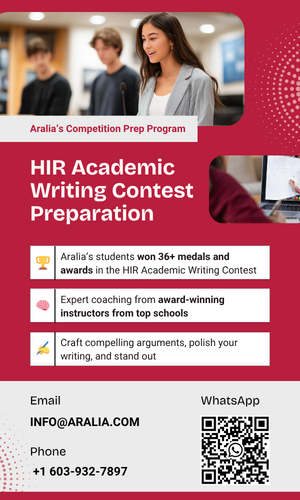
HIR Academic Writing Contest Prep
Prepare for the Harvard International Review Academic Writing Contest with an advanced global affairs course designed to help students craft a standout 800–1,200-word academic essay. Through expert instruction, analytical training, and hands-on writing workshops, students develop critical thinking and research skills.