

John Locke Essay Competition is an exceptionally prestigious writing contest designed for middle and high school students worldwide. With an overall winning rate of approximately 0.03%, the competition attracts thousands of brilliant young minds eager to test their intellectual abilities. Given the intense level of competition and the profound depth required by the prompts, aspiring writers need a solid foundation of knowledge and a distinct set of analytical skills to succeed.
1. About the John Locke Essay Competition
Organized by the John Locke Institute located in Oxford, United Kingdom, this competition encourages young scholars to cultivate the hallmarks of exceptional writers: independent thought, depth of knowledge, logical reasoning, and persuasive style. The essays are evaluated by a distinguished panel of senior academics and professors from world-renowned universities such as Oxford, Princeton, and Brown.
The competition is open to students from any country under 19 years old who meet the eligibility criteria for the submission year. Participants can choose from up to 10 diverse subject categories, including philosophy, politics, economics, history, psychology, theology, law, international relations, science and technology, and public policy.
The annual timeline for the 2027 cycle typically unfolds with essay questions released in February, registration and submission windows closing around May and June, shortlisted candidates announced in July, and the academic conference and awards dinner held in October.
2. What Does the John Locke Essay Competition Evaluate?
According to the John Locke Institute, the competition encourages students to develop five essential intellectual qualities: independent thinking, depth of knowledge, clear reasoning, critical analysis, and persuasive writing.
When evaluating submissions, judges consider students’ understanding of relevant concepts, use of evidence, originality, argumentation, essay structure, and ability to communicate their ideas convincingly.
These criteria can be grouped into three core academic abilities that students should develop before entering the competition.
Strong Understanding of Academic Concepts and Theories
John Locke essay questions often explore complex issues across philosophy, economics, politics, history, psychology, law, and other disciplines. To develop a convincing response, students need to understand the key concepts underlying their chosen question and recognize how different academic theories might approach the issue.
For example, an essay discussing individual liberty and government authority might draw on John Locke’s philosophy, particularly his theories of natural rights and social contracts. However, students are not required to connect every essay to John Locke’s philosophy. They should instead identify the theories and evidence most relevant to their chosen question.
Students should demonstrate depth of understanding by explaining complex ideas accurately, making meaningful connections between concepts, and applying their knowledge to develop a well-supported argument.
Strong Argumentative Writing and Research Skills
The competition places significant emphasis on the quality of students’ arguments, their use of evidence, and the clarity of their writing. A strong argumentative essay should directly answer the chosen question, present a clear thesis, and support its claims with logical reasoning and credible evidence.
Students must also organize their ideas effectively, ensuring that each paragraph contributes to their overall argument. Rather than simply summarizing research findings or presenting different opinions, they should explain how the evidence supports their conclusions.
Independent Thinking and Logical Analysis Methods
One of the most important qualities evaluated in the John Locke Essay Competition is a student’s ability to think independently.
Judges value original perspectives, logical reasoning, and thoughtful engagement with opposing arguments. Students should be able to question assumptions, evaluate conflicting evidence, and develop their own conclusions rather than simply repeating commonly accepted viewpoints.
For example, when discussing whether governments should regulate social media, students should consider not only the potential benefits of regulation but also concerns surrounding freedom of expression, censorship, and government authority.
A strong essay acknowledges these competing perspectives and explains why its central argument remains convincing. The John Locke Institute specifically highlights the importance of addressing strong counterarguments. The most compelling essays challenge readers to reconsider their assumptions and potentially change their minds.
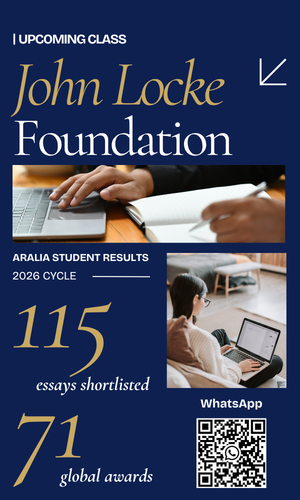
115 Aralia Students Named John Locke Essay Competition 2026 Shortlists!
With instruction from faculty in leading universities, Aralia’s international competition preparation programs have helped thousands of students worldwide pursue academic excellence and earn recognition in prestigious international competitions.
3. Five Signs Your Child Is Ready for the John Locke Essay Competition

Skill 1: Understanding Complex Questions and Academic Concepts
John Locke essay questions often explore philosophical, political, economic, or ethical dilemmas that do not have straightforward answers. Students must first understand what a question is asking before they can develop a meaningful response.
For example, one of the 2026 Philosophy questions asked:
“Is it ever wrong to do the right thing for the wrong reasons?”
A thoughtful response requires students to distinguish between the morality of an action and the morality of the intention behind it. Students might consider whether consequences matter more than intentions, whether a morally correct action can still reveal a flawed character, or how different ethical theories approach the question.
How to assess this skill: Give your child a previous John Locke essay question and ask them to explain what it means. Can they identify the underlying concepts, recognize possible interpretations, and explain why different people might disagree?
Skill 2: Developing a Clear Thesis and Structured Argument
A strong John Locke essay does not merely present information about a topic. It develops a focused argument that directly answers the chosen question.
Students should understand how to construct a thesis statement, organize supporting arguments, and build connections between their claims and evidence.
Consider the 2026 Science & Technology question:
“Is space exploration a necessity or an indulgence?”
A student who is still developing argumentative writing skills might write: “Space exploration is important because it helps us learn about the universe.”
A more developed thesis might argue:
“While space exploration is not essential for meeting humanity’s immediate needs, certain investments in space research can be justified by their long-term scientific benefits, provided they do not undermine urgent priorities on Earth.”
This argument establishes a clear position while recognizing the competing considerations involved. It also gives the student a framework for developing supporting paragraphs about scientific discovery, resource allocation, and public priorities.
How to assess this skill: Ask your child to write a short argumentative essay about a debatable topic. Can they formulate a clear thesis, provide supporting evidence, and organize their ideas into a coherent structure?
Skill 3: Conducting Independent Research and Evaluating Sources
The John Locke Essay Competition requires students to take greater responsibility for their own research. Students must be able to locate relevant academic resources, distinguish credible evidence from unsupported opinions, and determine how different sources contribute to their arguments. Strong research skills also involve evaluating the reliability of information rather than simply selecting evidence that supports an existing viewpoint.
For example, a student exploring whether social media contributes to political polarization may encounter opinion articles, survey findings, academic studies, and conflicting interpretations of the same issue. Rather than relying exclusively on sources that support their initial position, students should examine how different studies were conducted, consider alternative explanations, and evaluate the limitations of available evidence. This process allows them to develop more balanced, well-supported arguments.
How to assess this skill: Ask your child to research an unfamiliar topic and identify three credible sources. Can they explain why each source is trustworthy, summarize its key findings, and demonstrate how the evidence relates to their argument?
For additional guidance, explore Aralia’s article on writing strong thesis statements for research papers.
Skill 4: Thinking Critically and Addressing Counterarguments
One of the key qualities that distinguishes a strong academic essay is the ability to recognize and critically evaluate opposing perspectives. Students who are new to argumentative writing often focus exclusively on evidence that supports their position, overlooking arguments that challenge their conclusions. However, a persuasive essay should demonstrate that the writer understands different viewpoints and can explain why their own argument remains convincing.
For example, when discussing whether governments should regulate social media platforms, a student supporting stricter regulations might emphasize the risks of misinformation and online safety. A more sophisticated argument would also examine concerns about freedom of expression, potential government overreach, and the challenges of defining harmful content. By considering these competing perspectives, students can develop more nuanced arguments that acknowledge the complexity of the issue rather than presenting a one-sided opinion.
How to assess this skill: Ask your child to explain an opinion they hold and then consider why someone might disagree. Can they identify reasonable counterarguments, evaluate their strengths, and respond with logical reasoning rather than simply dismissing opposing views?
Reading previous John Locke prize-winning essays can help students observe how experienced writers construct arguments and engage with complex questions.
Skill 5: Writing Independently and Revising Based on Feedback
Writing a strong John Locke essay requires students to manage the entire writing process independently, from interpreting the question and conducting research to developing an outline, drafting arguments, and refining their final submission. As students explore different perspectives and discover new evidence, they may need to reconsider their initial arguments or adjust the direction of their essays. Students should be able to identify weaknesses in their reasoning, strengthen connections between evidence and claims, address gaps in their arguments, and reorganize ideas to improve clarity. In some cases, they may even need to reconsider their original thesis when their research leads to a different conclusion.
How to assess this skill: Ask your child to revisit an essay after receiving feedback from a teacher or mentor. Can they identify weaknesses in their arguments, explain which changes are necessary, and revise their work independently rather than simply following suggested corrections?
Aralia Students Are 4x More Likely to Publish a Research Paper
4. How to Prepare for the John Locke Essay Competition 2027
Students interested in the 2027 competition can begin strengthening their academic foundations before the official questions are released. Based on the 2026 competition schedule, questions were available in February, followed by a regular registration deadline in March and an essay submission deadline in May.
Students should consult the John Locke Institute’s official website for confirmed 2027 dates and requirements.
Starting Point 1: Academic Writing – Beginner
Students who have limited experience writing argumentative essays should first develop a strong understanding of essay structure, thesis statements, supporting evidence, and academic citations.
Aralia’s Academic Writing classes introduces students to persuasive and argumentative writing, rhetorical analysis, and effective revision techniques.
This class is suitable for students who need more practice expressing their ideas clearly before tackling complex competition questions.

Starting Point 2: John Locke Foundation
Students who already understand basic essay structure but need additional experience with academic research, critical analysis, and independent argument development can progress to Aralia’s John Locke Foundation Class.
The Foundation program introduces students to the essential skills required for John Locke preparation, including formulating research questions, evaluating academic sources, organizing evidence, and developing well-supported arguments.
Starting Point 3: John Locke Essay Competition Preparation
Students who already demonstrate strong academic writing and research abilities can advance to Aralia’s John Locke Essay Competition Preparation Class. This class focuses on applying established skills to the competition’s official questions.
Through a combination of small-group instruction and individualized guidance, students work on analyzing their chosen questions, developing original thesis statements, researching relevant sources, and strengthening their arguments.
The goal is to help students apply independent thinking and academic writing skills to their own original competition submissions.

John Locke Essay Competition Prep
In the John Locke Essay Competition Prep course, students will learn the ins and outs of essay writing, in preparation for entering the competition. We offer prep classes in all categories. Students will choose one topic, compose an original thesis and argument, and write an essay for submission. Students will engage in a guided analysis of primary and secondary sources, develop critical thinking skills, and discover interesting insights. In addition to the group classes, students will receive guidance on their individual projects from the instructor through one-on-one sessions.