

Drawing on the Open Doors 2026 Report and IIE’s Fall 2026 International Student Enrollment Survey, this article explores the latest trends in U.S. higher education, including declining international student enrollment, changes in student recruitment priorities, and shifting preferences in academic programs. It also examines what these developments mean for Vietnamese students and how families can better prepare for the U.S. college admissions process in the coming years.
1. International Student Enrollment in the U.S.: Key Findings
International Student Enrollment Declines After Years of Growth
On November 16, 2026, the Institute of International Education (IIE) released its Open Doors 2026 Report on International Educational Exchange.
The report confirms a shift in international student enrollment following several years of recovery from the COVID-19 pandemic. After steadily increasing and reaching an all-time high of 1,177,766 students in the 2024–25 academic year, enrollment fell to 1,146,163 in 2025–26.
This marks a notable change in the U.S. international education landscape, raising questions about whether the decline is temporary or signals a longer-term shift in student mobility.
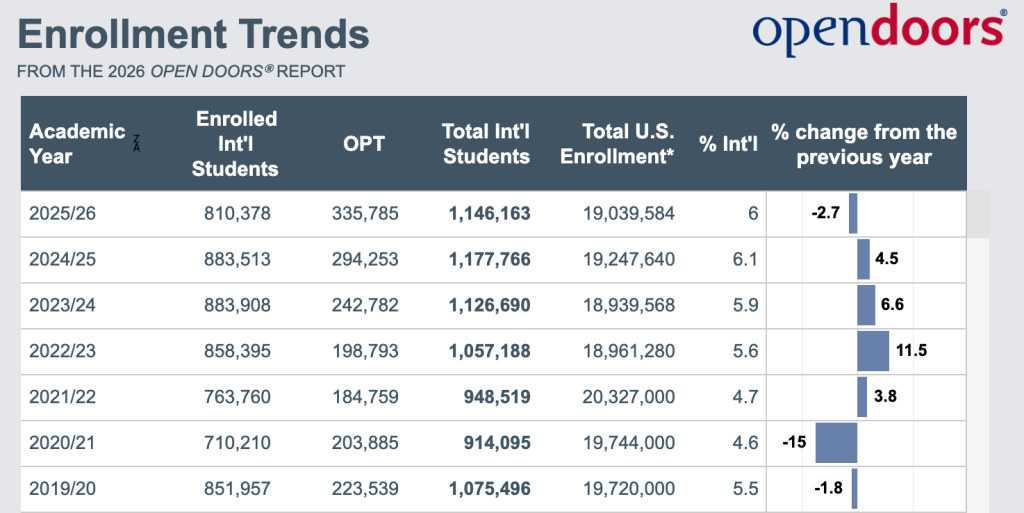
Source: Open Doors Open Doors năm 2026
However, the 2.7% decline does not necessarily mean that the U.S. is losing its appeal as a leading study abroad destination. With more than 1.14 million international students from over 210 countries and territories, the U.S. remains the world’s largest destination for international students.
What is more concerning is the gap between overall international student enrollment and the number of new students entering U.S. colleges and universities.
During the 2025–26 academic year, just 228,123 new international students enrolled at U.S. institutions, an 18% decrease from the previous year. This is one of the most significant findings in this year’s report, suggesting that challenges in attracting new international students extend beyond individual universities or academic programs and are being felt across the broader U.S. higher education system.
Stand Out in College Admissions with Aralia
Graduate Enrollment Drops 13%, While Undergraduate Numbers Remain Stable
The Open Doors 2026 Report reveals significant differences in international student enrollment across academic levels. Graduate programs experienced the sharpest decline among degree-seeking students, while undergraduate enrollment remained relatively stable.
Academic Level / Program | Enrollment (2025–26) | Annual Change |
Graduate | 423,078 | −13% |
Undergraduate | 356,165 | −0.3% |
Non-degree Programs | 31,135 | −18% |
Optional Practical Training (OPT) | 335,785 | +14% |
Source: Open Doors 2026
Graduate enrollment saw the largest decline among degree-seeking students. Although graduate students remain the largest group of international students in the U.S., enrollment fell by 13%, largely driven by a 22% decrease in master’s degree students. In contrast, doctoral enrollment increased by 3%, suggesting that interest in advanced research opportunities remains relatively strong.
Undergraduate enrollment remained stable, with 356,165 international students, a slight decline of just 0.3%. This is a relatively encouraging sign for high school students considering U.S. colleges and universities in the coming years.
OPT participation continued to grow, increasing by 14% to 335,785 students. Optional Practical Training (OPT) allows eligible F-1 international students to gain work experience related to their field of study during or after completing their academic programs. The increase suggests that many international students who completed their studies in previous years continued gaining professional experience in the U.S.
Vietnam's U.S. Student Enrollment Hits a 25-Year High as Major Markets Decline
While international student enrollment in the U.S. declined overall in 2025–26, trends varied significantly across countries. India, China, and South Korea remained the three largest sources of international students, but all experienced enrollment declines. Meanwhile, several other countries, including Vietnam, Nepal, and Bangladesh, continued to see growth.
Vietnam’s enrollment increased by 6.5% to 27,257 students, the highest level recorded in 25 years since IIE began tracking Vietnamese students separately. Vietnam also maintained its position as the sixth-largest source of international students in the U.S.
Here’s how enrollment changed across major sending countries:
Country | Enrollment (2025–26) | Annual Change |
India | 339,435 | −6.5% |
China | 254,458 | −4.3% |
South Korea | 40,874 | −3.4% |
Canada | 31,125 | +4.1% |
Nepal | 29,058 | +16.7% |
Vietnam | 27,257 | +6.5% |
Bangladesh | 22,534 | +11.8% |
Source: Open Doors 2026
India remains the largest source of international students, accounting for nearly 30% of total enrollment, followed by China at 22.2%. Together with South Korea, these three countries account for more than half of all international students in the U.S.
However, their declining enrollment contrasts with the growth seen in emerging and expanding markets. Nepal recorded a 16.7% increase, followed by Bangladesh at 11.8% and Vietnam at 6.5%.
These shifts suggest that international student enrollment is becoming more geographically diverse. For U.S. universities, this creates an incentive to expand recruitment efforts beyond their traditional markets, while Vietnam’s continued growth highlights its increasing importance in the international education landscape.
2. Why Is International Student Enrollment Declining in the U.S.?
The decline in international enrollment cannot be attributed to a single factor. According to IIE’s Fall 2026 Snapshot Survey, U.S. colleges and universities identified several challenges influencing international students’ enrollment decisions.
Visa Processing and Immigration Uncertainty
According to the survey, 88% of participating institutions identified visa application challenges as a factor contributing to declining new international student enrollment.
These challenges include long interview wait times, processing delays, and visa denials. Even students who have secured university admission may struggle to begin their studies on time if their visa applications are delayed.
Immigration policy changes and the broader political environment have also influenced students’ decisions. The survey found that:
- 70% of institutions cited concerns about international students not feeling welcome in the U.S.
- 63% identified concerns about the broader political and social environment.
What this means for families: Students should plan for visa applications, financial documentation, and enrollment requirements well before their intended start date, rather than focusing solely on university application deadlines.
Rising Education Costs
Studying in the U.S. can require a significant financial investment, particularly for international students who often pay higher tuition rates at public universities than in-state residents.
According to IIE, 45% of surveyed institutions identified the cost of studying in the U.S. as a factor affecting international enrollment.
Financial aid availability also varies considerably. While some universities offer substantial scholarships and need-based aid to international students, others provide limited assistance.
Families should therefore evaluate the total cost of attendance, including tuition, housing, living expenses, and potential financial aid, when building a college list.
Growing Competition from Other Study Destinations
Students now have more options for pursuing an international education. Countries such as the United Kingdom, Canada, Australia, and Germany continue to compete for international students through academic programs, recruitment initiatives, and post-graduation opportunities.
In IIE’s survey, 60% of institutions reported that students choosing other countries contributed to declining international enrollment.
As competition increases, U.S. universities must continue demonstrating the value of their academic programs, student support services, and career development opportunities.
3. U.S. Study Abroad Outlook for 2027: What Should Students Expect?
While Open Doors 2026 reports enrollment figures for the 2025–26 academic year, IIE’s Fall 2026 Snapshot provides an early look at trends for 2026–27.
The survey includes responses from 809 U.S. higher education institutions. Because it represents a subset of institutions rather than the entire U.S. higher education system, its findings should be viewed as preliminary indicators, not final nationwide enrollment figures.
International Enrollment May Face Continued Pressure
Participating institutions reported a 9% decrease in total international student enrollment in fall 2026 compared with fall 2025. The declines affected multiple groups:
- Undergraduate enrollment: down 3%
- Graduate enrollment: down 15%
- OPT participation: down 6%
- New international student enrollment: down 15%
These early findings suggest that international recruitment challenges may continue into the 2026–27 academic year, particularly at the graduate level. However, declining enrollment does not necessarily mean that U.S. universities are reducing their commitment to international education.
Excel in International Academic Competitions with Aralia
U.S. Universities Continue to Prioritize International Recruitment
Despite recent challenges, 81% of surveyed institutions identified international student recruitment as a priority, while 75% reported maintaining or increasing their recruitment budgets.
International students remain valuable to U.S. universities for several reasons:
- 75% of institutions recognized the diverse academic and cultural perspectives international students bring to campus.
- 60% emphasized their financial contributions.
These findings highlight the important role international students continue to play in U.S. higher education, both academically and economically.
A diverse student population enriches campus life by bringing together different perspectives, encouraging cross-cultural exchange, and preparing students to work in an increasingly global environment.
International students also make a significant economic contribution. According to IIE, international students contributed nearly $56 billion to the U.S. economy in 2025.
STEM Fields Remain a Top Recruitment Priority
Another key finding from this year’s report is the continued emphasis on STEM (Science, Technology, Engineering, and Mathematics) programs. According to the Fall 2026 Snapshot Survey, 91% of participating U.S. institutions identified STEM fields as a priority for international student recruitment.
The academic fields receiving the most attention include:
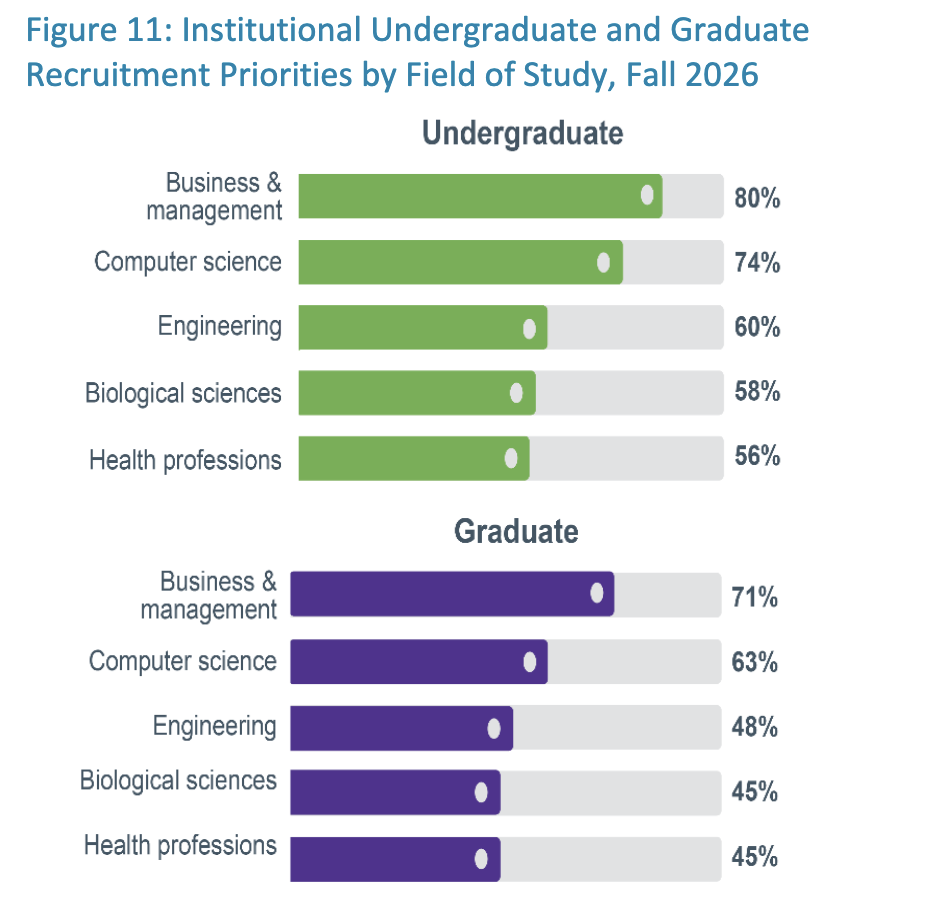
Source: IIE, Fall 2026 Snapshot
This emphasis on STEM is evident across different types of institutions, from major research universities to community colleges. Notably, 99% of institutions with more than 10,000 students reported prioritizing international recruitment in STEM fields.
Beyond traditional disciplines such as computer science and engineering, emerging fields like artificial intelligence, robotics, cybersecurity, data science, and agricultural technology are also attracting growing interest.
However, STEM is not the only area of focus. Business and management programs remain important recruitment priorities at both the undergraduate and graduate levels. This suggests that U.S. universities continue to seek students with a wide range of academic interests and strengths, rather than focusing exclusively on technology-related fields.
Universities Are Also Recruiting International Students Already in the U.S.
Another emerging trend is universities’ increasing outreach to international students who are already studying in the country.
According to IIE, 57% of surveyed institutions reported recruiting international students directly from U.S. high schools, while 48% actively recruited international undergraduates for graduate programs.
What Do These Trends Mean for Students Planning to Study in the U.S.?
The latest data presents a mixed but important picture: international student enrollment is declining, yet U.S. colleges and universities continue to prioritize international recruitment. While challenges related to visa processing, costs, and immigration policies remain, opportunities to pursue higher education in the U.S. are still available.
For students planning to apply to U.S. colleges in 2027 and beyond, there are three important takeaways.
Start preparing early. Beyond maintaining strong grades and preparing for standardized tests, students should develop academic writing, critical thinking, and research skills. Families should also plan ahead for application deadlines, financial documentation, and visa requirements.
Build a well-balanced college list. Rather than focusing solely on rankings, students should consider academic programs, affordability, financial aid opportunities, campus environment, and the support available to international students.
Focus on meaningful academic development. Whether students are interested in STEM, business, humanities, or other fields, they should pursue activities that reflect their genuine interests. Academic competitions, research projects, and extracurricular involvement can help students explore their strengths and demonstrate intellectual curiosity.
Ultimately, the changing international education landscape does not mean that studying in the U.S. is becoming less worthwhile. Instead, it highlights the importance of making informed decisions and preparing strategically. By understanding admissions trends, exploring their academic interests, and identifying universities that align with their goals, students can approach the U.S. college admissions process with greater confidence.
Prepare for U.S. College Admissions with Aralia
Building a competitive U.S. college application takes more than strong grades. Students also need to develop academic writing, critical thinking, and research skills while pursuing meaningful activities that demonstrate their initiative and intellectual curiosity.
Aralia is an online education platform for students in Grades 6–12, offering academic programs taught by experienced educators. Through small-group classes and personalized instruction, Aralia helps students:
- Strengthen essential academic skills, including critical reading, academic writing, and analytical thinking.
- Prepare for international academic competitions, including the John Locke Essay Competition, Harvard International Review Academic Writing Contest, Diamond Challenge, and more.
- Explore academic research through guided projects with university professors and instructors.
- Build a strong academic foundation to prepare for the expectations of high schools and universities.