

Scholastic is a great choice for students interested in creative writing, poetry, and longer literary pieces, while The New York Times offers shorter writing challenges and opportunities for students to have their winning work published online. This guide covers the key differences between the two contests, including eligibility, submission fees, awards, and the 2026–2027 competition calendar.
1. What Are the Scholastic Writing Awards and New York Times Student Contests?
Scholastic Art & Writing Awards
Organized by the Alliance for Young Artists & Writers, the Scholastic Art & Writing Awards is one of the longest-running recognition programs for creative teenagers in the United States.
The competition accepts submissions in several writing categories, including poetry, short stories, personal essays, critical essays, and journalism. Students can submit multiple pieces, provided each follows the requirements for its category.
Students first compete at the regional level, where they may receive a Gold Key, Silver Key, or an Honorable Mention. Regional Gold Key recipients automatically advance to national judging, where they can earn national medals and other awards. National Gold Medal recipients are also celebrated during National Awards Week, which includes a ceremony at Carnegie Hall in New York City.
Read Aralia’s Complete Guide to the Scholastic Art & Writing Awards for more information.
The New York Times Learning Network Student Contests
The New York Times Learning Network organizes writing and creative contests for middle and high school students throughout the academic year. The New York Times offers several contests with different themes and formats. Students might be asked to write a short personal memoir, develop an opinion piece, interview someone working in STEM, or produce an audio story.
For the 2026–2027 school year, the contest lineup includes My Tiny Memoir, Open Letters, Audio Stories, and other creative challenges.
Winning submissions are published on The New York Times Learning Network website. This gives students the opportunity to share their work with readers beyond their classrooms.
2. Who Can Enter? Eligibility and Submission Fees
| Criteria | Scholastic Art and Writing Awards | New York Times Student Contests |
| Eligibility | Students in grades 7–12 | Students ages 13–19 enrolled in middle or high school |
| Geographic eligibility | Students in the United States, U.S. territories, and eligible international schools | Students worldwide, subject to contest rules |
| Entry fee | $15 per individual entry; $40 per senior portfolio | Free |
Scholastic’s entry fees are worth considering for students planning to submit several pieces. For example, entering three individual works would cost $45 before any fee waiver. Students who need financial assistance can request a fee waiver through the submission process.
The New York Times contests are free, so they are more accessible to students who want to try different writing formats without paying for each submission.
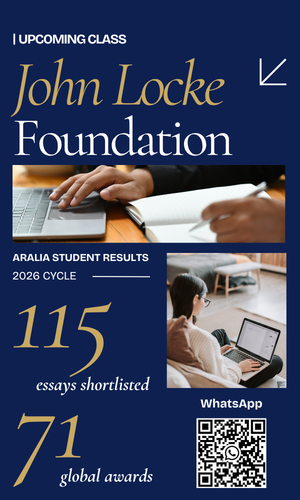
115 Aralia Students Named John Locke Essay Competition 2026 Shortlists!
With instruction from faculty in leading universities, Aralia’s international competition preparation programs have helped thousands of students worldwide pursue academic excellence and earn recognition in prestigious international competitions.
3. What Types of Writing Can You Submit?
Scholastic Writing Awards
Scholastic offers a wide range of writing categories. Students can submit work they have developed independently, in school, or through writing workshops, as long as the work meets the competition’s originality and submission requirements.
Writing Category | Word or Length Limit |
Critical Essay | 500–3,000 words |
Flash Fiction | Maximum 1,000 words |
Journalism | 500–3,000 words |
Personal Essay & Memoir | 500–3,000 words |
Poetry | 3–100 lines |
Screenplays & Scripts | 500–3,000 words |
Short Story | 1,000–3,000 words |
Speculative Fiction | 500–3,000 words |
Novel | Excerpt up to 3,000 words, plus a 250-word synopsis |
Students interested in fiction can choose between short stories, flash fiction, speculative fiction, and novel excerpts, depending on the nature of their work.
The variety of categories also allows students to explore multiple writing styles. A student could submit a poem and a critical essay in the same competition year, as long as each is entered separately under the appropriate category.

New York Times Student Contests: Shorter Writing and Creative Challenges
The New York Times contests change from year to year. Rather than maintaining a fixed set of literary categories, the Learning Network introduces specific assignments with their own prompts, formats, and deadlines.
For 2026–2027, examples include:
- My Tiny Memoir: Write about a meaningful personal experience in just 100 words.
- Open Letters: Develop a persuasive open letter of up to 500 words.
- Audio Stories: Tell a story through a podcast of up to five minutes.
- The STEM Interview: Produce a short video interview related to science, technology, engineering, or mathematics.
- What It’s Like to Grow Up in 2026: Communicate an experience of growing up through visual art.
An important rule for 2026–2027: The New York Times prohibits the use of generative AI for drafting, editing, translation, and media creation in its student contests. Students may also be asked to provide evidence of their writing process, such as Google Docs version history, so make sure to review the complete AI policy for each contest before submitting.
4. How Are Submissions Judged, and What Can Students Win?
Scholastic Writing Awards
Scholastic evaluates submissions based on three main criteria:
- Originality: Does the work present a distinctive idea, perspective, or creative approach?
- Skill: How effectively does the student use language, structure, and writing techniques?
- Emergence of a Personal Voice or Vision: Does the writing reveal an individual perspective or artistic identity?
New York Times Student Contests
Each contest has its own judging rubric, which may assess qualities such as originality, clarity, effective storytelling, persuasive reasoning, or use of credible evidence. The Learning Network selects winners, runners-up, and honorable mentions.
Publication gives students a piece of writing they can share with teachers, classmates, and future readers. It can also be included in a writing portfolio or referenced in college applications when relevant.
5. Scholastic vs. New York Times: 2026–2027 Competition Deadlines
Scholastic Writing Awards 2026–2027 Timeline
The Scholastic competition follows an annual schedule, although submission deadlines differ by region.
Event | Date |
Submission portal opens | October 1, 2026 |
First regional deadlines | December 1, 2026 |
Final regional deadlines | As late as January 4, 2027 |
Regional Announcement Day | January 27, 2027 |
National Announcement Day | March 31, 2027 |
National Awards Week | June 8–11, 2027 |
Students should check the official Scholastic calendar to confirm the deadline for their region.

New York Times Student Contest Calendar 2026–2027
Contest | Submission Period |
My Tiny Memoir | September 16 – October 28, 2026 |
What It’s Like to Grow Up in 2026 | October 28 – December 9, 2026 |
The STEM Interview | January 6 – February 17, 2027 |
Open Letters | February 17 – March 31, 2027 |
Audio Stories | March 31 – May 12, 2027 |
Voice and Choice Summer Reading | June 4–11, July 2–9, and July 30 – August 6, 2027 |
The Learning Network also offers an ongoing Current Events Conversation.
For more information, see Aralia’s New York Times Student Contest Calendar 2026–2027.
Aralia Students Are 4x More Likely to Publish a Research Paper
6. Scholastic Writing Awards vs. New York Times: Which Is Better for You?
Choose the Scholastic Writing Awards If You:
- Enjoy creative writing, including fiction, poetry, memoirs, or literary essays.
- Have an existing piece that you want to revise and submit.
- Want your writing evaluated through a regional and national awards system.
Are interested in scholarships or submitting a writing portfolio during your senior year.
Choose The New York Times Student Contests If You:
- Enjoy personal narratives, journalism, opinion writing, or current events.
- Prefer shorter assignments with specific prompts.
- Want to try different types of writing throughout the school year.
- Are interested in publishing your work for a broader audience.
- Want to participate in a free competition.
The New York Times can be an appealing option for students who are still exploring their writing interests.
Can You Enter Both Competitions?
Students who meet the eligibility requirements can participate in both programs. Preparing for different competitions can help students become more versatile writers. A Scholastic short story may require careful character development and narrative structure, while a New York Times opinion piece might demand a clear, evidence-based argument.
However, entering both should not come at the expense of writing quality. Students who are new to competitions may benefit from focusing on one strong submission before taking on additional projects.
Prepare for Writing Competitions With Aralia Education
Writing competitions give students an opportunity to challenge themselves beyond regular classroom assignments. They also require careful preparation, especially when students are learning to develop original ideas, organize longer pieces, or revise their writing for a specific audience.
Aralia offers writing classes, writing competition preparation programs, and an Academic Writing Lab to help students strengthen their writing skills.
Through personalized instruction and feedback, students can work on creative writing, essay development, literary analysis, and the revision process.
In 2026, Aralia students received 142 awards in the Scholastic Art & Writing Awards.
Whether you are preparing your first competition submission or working on a more advanced writing portfolio, Aralia’s instructors can help you develop the skills needed to approach challenging writing assignments with greater confidence.