

The HIR Academic Writing Contest 2026 invites students to explore pressing global issues through three themes, with Theme A: Global Culture in the Digital Era standing out as particularly relevant in today’s interconnected world.
In this guide, we break down what Theme A demands of its writers, how students can approach it effectively, and what strategies can help turn a good idea into an outstanding essay.
1. Why Students Should Join the HIR Academic Writing Contest 2026
For high school students pursuing academic experience beyond the classroom, this competition offers a chance to:
- Engage with real-world global issues
- Develop research and analytical skills, as well as structured argumentation
- Build early exposure to academic writing at an international level
- Earn international recognition that can strengthen college applications
Finalists will have the opportunity to participate in HIR Defense Day, where they can present and defend their ideas to the judges from Harvard University. This adds another layer of skill development, including public speaking and the ability to think critically under pressure.
Unlock Your Writing Potential: Students in Our Writing Competition Preparation Class Are More Likely to Secure Awards
2. What are the Themes of the Senior Category?
Participants in the senior category must choose one of three thematic prompts and must clearly indicate their selected prompt in their submission:
- Theme A: Global Culture in the Digital Era
- Theme B: Security in a Multipolar World
- Theme C: Technology, Innovation, and Power
2026 HIR Academic Writing Contest: New Age Category and Changes from 2025
3. Understanding Theme A: Global Culture in the Digital Era
“From social media and streaming platforms to online communities and digital art, technology is reshaping how culture is created, shared, and understood across borders. We invite students to explore how identity, language, tradition, and cultural influence evolve in an interconnected world. Possible topics include global youth culture, digital diaspora communities, cultural preservation online, internet-driven activism, and the international spread of music, film, and sports fandom.”
What This Theme Is About
Theme A is about technology and cultural power. It moves beyond traditional notions of invention and focuses on how digital technologies function as cultural forces. The central question is what digital platforms enable: whose voices are amplified, whose traditions are flattened or commodified, and how cultural authority has been redistributed in the platform era.
Historically, cultural influence has always been concentrated within institutions such as media conglomerates, governments, and cultural elites. They are those who usually controlled the channels through which ideas traveled. Today, individuals, communities, and even niche subcultures can now participate in shaping global conversations in ways that were not previously possible. Yet the infrastructure facilitating all of this remains privately owned and unevenly accessible.
Strong essays will grapple with this tension. Students are encouraged to explore questions such as:
- How is culture created and shared differently in the digital era than in previous decades?
- How do online platforms influence identity, language, and traditions?
- Who has the power to shape global culture, and who does not?
- Which cultures are amplified and widely shared?
- Which cultures are marginalized, overlooked, or commercialized?
78% of Aralia Students Win Prizes in the HIR Academic Writing Competition
4. Choose Your Topic
A common mistake is selecting a well-known phenomenon and treating its familiarity as sufficient grounds for an essay. For example, writing about “K-pop and its global popularity” may seem like a strong choice, but in practice, the topic’s ubiquity in popular discourse makes it difficult to advance anything that hasn’t already been said, unless you introduce an original analytical angle.
A more productive framing might look like this: “How does South Korea’s government-supported cultural export strategy (the ‘Hallyu’ wave) compare to the structural challenges faced by African music industries that achieve global reach without similar institutional support?” This introduces comparison, a question of power and inequality, and critical thinking that sustains a rigorous essay.
The best topics for Theme A share a few characteristics: they introduce a clear argument about power and structure. They push you to think about why certain cultural products succeed globally while others struggle, and to connect specific cultural phenomena to broader claims about the systems that shape global culture.
5. How to Structure the Essay
Start with a strong, specific example
Begin with a concrete digital cultural phenomenon, such as a viral trend, a global fandom, or an online movement. Connect this to a broader argument about global cultural power, influence, or inequality. More than being engaging and relatable, a well-chosen opening example signals to the reader that the essay will be grounded in evidence rather than abstraction.
Define key concepts clearly
Terms like “culture,” “digital era,” and “influence” may seem obvious, but they can be interpreted in different ways. Ambiguity in foundational definitions will undermine the consistency of the argument that will follow. Take time to stake out your terms:
- Does “culture” refer to artistic production, everyday social practice, or collective identity?
- Does “influence” mean algorithmic visibility, economic dominance, or the power to shape aesthetic norms?
- Is “the digital era” a technological condition or a specific political economy defined by platform capitalism?
Making these distinctions early on helps in several ways. It strengthens your argument by ensuring that your claims are consistent and well-scoped. It prevents confusion for the reader, who can follow your reasoning without confusion. Most importantly, it demonstrates a level of academic precision and clarity that sets stronger essays apart.
Develop a global comparison
A strong Theme A essay should include at least two different national or regional contexts. Not simply name-dropping examples from different parts of the world, but examining how the same digital phenomenon operates differently across distinct political and cultural environments, and why those differences matter. Ask yourself:
- How does this phenomenon look in different parts of the world?
- Why do these differences matter on a broader scale?
This comparative approach is essential for showing depth and global awareness, setting your essay apart from other submissions.
Build a clear argument about power
Throughout the essay, return to the question of who benefits from the systems you are examining, and who does not. Digital platforms may appear open and accessible, and in certain respects, this is accurate. But in practice, visibility and influence on social media are often shaped by deeper forces, such as corporate algorithms, state support, or unequal access to resources.
A rigorous essay does not simply note that inequality exists; it explains the mechanisms through which it operates, and where possible, evaluates what might be done about it.
Related Resource:
- 2026 Theme Analysis: Harvard International Review Academic Writing Contest
- Junior Theme Analysis for the Harvard International Review Academic Writing Contest 2026
- Senior Theme B Analysis for the Harvard International Review Academic Writing Contest 2026
- Senior Theme C Analysis for the Harvard International Review Academic Writing Contest 2026
Preparing for HIR with Expert Instructors
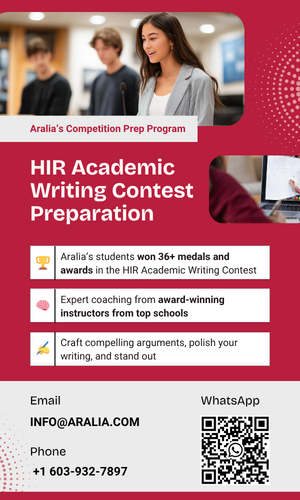
If you’re looking for structured guidance, Aralia’s HIR Academic Writing Contest preparation program offers you support at every stage: from idea development to final submission.
Aralia students have earned multiple Gold, Silver, and Bronze awards, as well as numerous High Commendations and Excellence in Writing distinctions. With the right mentorship and preparation, students can significantly strengthen their writing and their chances of success.

HIR Academic Writing Contest Prep
Prepare for the Harvard International Review Academic Writing Contest with an advanced global affairs course designed to help students craft a standout 800–1,200-word academic essay. Through expert instruction, analytical training, and hands-on writing workshops, students develop critical thinking and research skills.