


In the age of artificial intelligence, AI is not only transforming how we live but why we live, raising critical questions about ethics and responsibility. As a result, the role of the AI Ethicist has become a new career with a rapidly increasing global demand.
This article helps you understand what an AI Ethicist is, why this role is becoming increasingly important, and the academic pathways and skills needed to pursue it. At the same time, it offers clear guidance for high school students: building an interdisciplinary foundation between technology and society, developing critical thinking, participating in relevant extracurricular activities, and learning to use AI responsibly.
Since 2018, the demand for AI Ethics roles has grown significantly. Not only has the number of positions increased, but data also shows a rising proportion of AI ethics roles within the broader AI job market. According to a 2025 study, there are currently more than 100,000 positions each year for professionals with expertise in AI Ethics. A report from McKinsey & Company also highlights that more organizations are proactively creating dedicated roles in AI Ethics and AI Governance as part of their AI workforce strategy. AI Ethics is no longer a supporting role, but it is becoming a core competency within the modern AI ecosystem.
1. What Is an AI Ethicist?

An AI Ethicist is a professional who focuses on ensuring that artificial intelligence systems are designed, deployed, and used responsibly, fairly, and transparently.
Simply put, if AI engineers are the ones who build the systems, AI Ethicists are the ones who continuously ask critical questions before, during, and after that process:
- Is this system biased against any particular group of people?
- Could it cause harm to anyone?
- Is user privacy being violated?
- Are the decisions made by AI transparent and explainable?
85% of Aralia Students Place in Top Writing Competitions
The role of an AI Ethicist requires a strong understanding of technology and the ability to provide concrete, real-world AI decisions, from how data is collected and how algorithms are designed to how AI products are deployed and how they impact society.
AI Ethicists serve as a bridge between technology and humanity, helping them ensure that the development of AI is not only fast but also heading in the right direction.
2. Why Is the Demand for AI Ethicists Increasing Rapidly?
AI Is Creating Ethical Challenges
AI is deeply involved in decisions that affect people’s daily lives, from recommending the content you watch and screening job applications to supporting medical diagnoses. As a result, a range of ethical risks has begun to emerge:
- Algorithmic bias can lead to discrimination between different groups of people
- Deepfakes and misinformation are spreading at an unprecedented speed and level of sophistication.
- Automation is replacing human labor, increasing social inequality
- Automated decision-making systems lack clear accountability when errors occur
The most concerning aspect lies in the scale: how a small error in data or algorithms can lead to large-scale consequences. Therefore, ethical issues related to AI require organizations to address them from the very beginning of system design.
Governments Are Tightening AI Regulations
In response to the growing AI risks, governments and international organizations have begun introducing regulatory frameworks to govern AI development.
One major milestone is the European Union’s AI Act, the world’s first comprehensive set of AI regulations, establishing strict standards for safety, transparency, and accountability. In addition, the United States and many other countries are developing policies to promote responsible AI development. At the same time, many international organizations and companies are advancing Responsible AI standards as a mandatory part of their technology strategies.
This has created an important shift: companies are no longer required only to build AI systems that function effectively; they must also ensure those systems comply with legal and ethical standards. And to achieve this, they need individuals who understand both technology and ethics: AI Ethicists.
Large Companies Are Investing Heavily in AI Ethics
Leading firms such as Google, IBM, NVIDIA, and Adobe have all made AI ethics a visible part of their long-term strategy. Companies are actively hiring AI ethics specialists to work alongside engineers and product teams, ensuring that ethical considerations are built into development from the start. Many are also establishing dedicated AI governance teams who are responsible for setting internal standards, reviewing high-risk systems, and aligning products with emerging regulations. At the same time, there is a growing emphasis on internal education, with engineers and data scientists receiving training in “Responsible AI” to better understand the social impact of the technologies they build.
High Demand but Limited Talent Supply
Despite the rapid growth in demand, the talent pool in this field has not yet kept pace. AI Ethicist is still a very new profession, and formal training pathways are not yet widespread. Unlike traditional fields, this role requires a combination of knowledge across multiple domains, which can be challenging to develop within a traditional academic track.
At its core, AI ethics sits at the intersection of technology, policy, and human values. Professionals in this space need to understand how AI systems are built, how data is used, how to interpret legal frameworks, how to evaluate ethical principles, and how to consider business implications. This interdisciplinary nature is what makes the field both intellectually demanding and difficult to staff, as candidates rarely have expertise spanning all of these areas.
In addition, AI ethics professionals need strong critical-thinking skills, the ability to analyze complex situations, and the capacity to make decisions when there is no single correct answer.
According to a survey by McKinsey & Company, roles related to AI ethics are among the hardest to fill today.
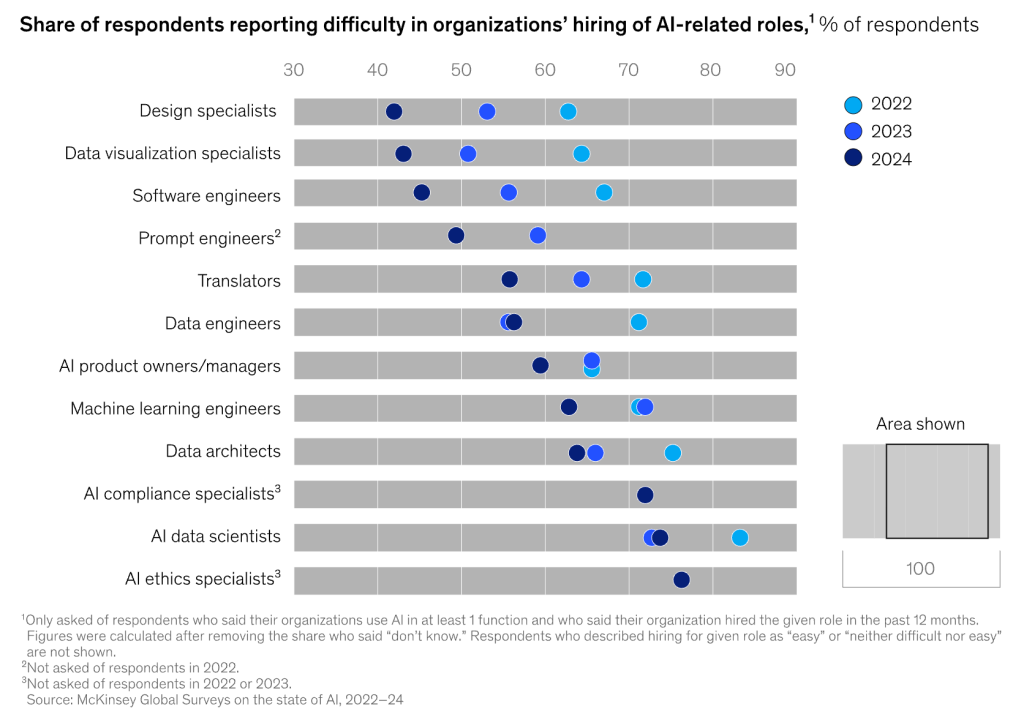
Source: Screenshot from a McKinsey & Company report
3. How to Become an AI Ethicist
Recruiting for AI ethics roles is challenging because of the field’s evolving nature, as well as the relatively long, complex training pathway required. To become an AI Ethicist, you need to build the following foundations:
Essential Knowledge
An AI Ethicist does not need to be the best coder on the team, but they must have a solid understanding of how AI systems work. This includes:
- How AI operates: from machine learning and data to models
- The differences between approaches, such as supervised and unsupervised learning
- How data is collected, processed, and used within systems
- The limitations and risks of AI (bias, lack of transparency, etc.)
The key point is this: an AI Ethicist is not the one building the system, but the one who understands it well enough to know when to ask critical questions. Without understanding the technology, you won’t be able to identify where ethical issues arise. But if you only understand the technology without a societal perspective, you won’t recognize what is truly concerning.
Key Skill Sets
AI Ethics requires a combination of diverse skill sets. A strong AI Ethicist typically has:
- Strong critical thinking skills: the ability to ask questions and view problems using multiple perspectives
- Knowledge of society, law, and policy: to assess the broader impact of AI
- Communication skills: to work with engineers, lawyers, managers, and end users
- The ability to analyze complex situations: especially in cases without clear right-or-wrong answers
- Decision-making skills under uncertainty
Learning Pathway
There is no single path to becoming an AI Ethicist, but there are several common routes. According to the University of San Diego, here is a typical learning pathway:
Undergraduate level: You can start with one of the following foundations, such as Computer Science, Philosophy, Economics, or other social sciences. You may also choose a double major in computer science and philosophy to build the essential interdisciplinary foundation required for an AI ethics professional.
Graduate level: you can specialize further in areas such as:
- AI or Data Science with an ethics focus
- Public Policy / Technology Policy
- Interdisciplinary programs combining AI and Ethics
There is no strict requirement to hold a PhD to work in AI ethics. In fact, more universities are now offering specialized master’s programs (such as at the University of Cambridge) or short postgraduate programs (such as at the University of Illinois Urbana-Champaign) that integrate technology and society to prepare students for this field. In the future, the educational pathway for this profession may continue to evolve, so students should stay up to date with the latest information.
Unlock the Power of AI for Learning and Writing
Practical Experience
AI Ethics is a field that you truly understand only by engaging with real-world situations. Some ways to build early experience include:
- Participating in projects or research related to AI ethics
- Working on projects involving bias, fairness, or privacy
- Interning at tech companies or research organizations
- Joining competitions, workshops, or conferences on AI, technology, and society
These experiences help students move from simply understanding problems to actually solving problems, a crucial step if you want to pursue an AI ethics career.
4. What Should High School Students Prepare to Become an AI Ethicist?
For high school students who plan to pursue AI ethics and become AI Ethicists, starting early is very important. What makes this field unique is that you cannot excel in just one area; you need a strategic, interdisciplinary preparation from an early stage.
Build a dual foundation: Technology + Society
A common mistake when choosing a field is thinking you must pick either a technical path or a social sciences path, but not both. In reality, AI Ethicists stand at the intersection of these two domains. Instead of choosing one side, you should:
- Start with basic technical knowledge, such as Python, introductory machine learning, or how AI systems work
- At the same time, actively explore social issues related to technology, such as inequality, privacy, or newly introduced technology regulations
The goal is not to specialize too deeply, too early, but to understand how technology impacts people.
Develop Critical Thinking
AI Ethics is not a field with clear-cut right-or-wrong answers. It involves open-ended questions in which every decision entails trade-offs. Therefore, the most important skill for an AI Ethicist is critical thinking.
You can develop this skill by:
- Participating in debate activities to learn how to view issues from multiple perspectives
- Writing essays on topics related to technology and society (e.g., Should AI replace humans in recruitment?)
- Analyzing real-world cases, such as bias in AI-driven hiring or credit evaluation systems
These activities not only help you express your opinions but also teach you how to build and defend your arguments.
Relevant Extracurricular Activities
Some suitable extracurricular options for students interested in AI Ethics include:
- Conducting research related to AI, sociology, or economics
- Joining summer programs focused on AI, technology, or public policy
- Participating in international essay competitions, such as the John Locke Essay Competition, especially by choosing topics related to technology and ethics
These experiences will help you build both the knowledge and mindset needed to pursue AI ethics seriously.
Understanding Responsible AI Use
In addition to acquiring knowledge and participating in activities, one important foundation that students often overlook is understanding how to use AI responsibly.
This is not just a practical skill, but also the first step in developing an ethical mindset in technology. If you want to pursue AI Ethics in the future, you need to clearly understand the weaknesses and ethical risks that AI can create, the current solutions to mitigate these risks (such as fairness, explainability, and data governance), and the regulations and standards being applied to manage AI. In other words, before you can “evaluate” AI, you need to know how to use it properly.
For students, this can start with very familiar situations, such as using AI for studying and essay writing. For example, instead of relying entirely on AI, you should learn how to:
- Use AI as a support tool, not a replacement for thinking
- Verify the information provided by AI
- Maintain your own perspective and creativity in your writing
You can also explore courses like Aralia’s Responsible AI Use in Academic and English Writing. This course not only helps you use AI more effectively but also trains you to integrate technology into your learning process while preserving critical thinking, an essential component of AI Ethics.

The rise in demand for AI Ethicists is an inevitable result of the reality that technology is advancing much faster than humanity’s ability to control and adapt to it. In the near future, AI will no longer be a standalone field but will spread through almost every industry, from education and healthcare to finance, law, and media. For this reason, both companies and governments will be compelled to invest seriously in AI ethics if they want to achieve sustainable development and avoid major legal and reputational risks.
In this context, AI Ethicists have the potential to become one of the most important professions of the 21st century, not only because of high demand but also because of their role in shaping how technology impacts society.
For high school students, this is a particularly exciting path. It is a highly interdisciplinary field that opens up a wide range of future career opportunities for them to explore. More importantly, it is a career with clear social significance, where you are not only working with technology but also helping ensure it serves people well.
5. Learn about AI with Aralia's Instructors

Responsible Use of AI in Academic and English Writing
This Responsible Use of AI in Academic and English Writing course is designed to teach students how to integrate artificial intelligence (AI) tools into their academic and English writing processes responsibly, effectively, and ethically.