

This article breaks down the full 2026 U.S. News Law school rankings, starting with how Stanford overtook Yale. We will walk through the complete top 15 rankings table, explain the methodology behind the numbers, and highlight the biggest movers.
Stand out in the college admission process
1. Changes in the 2026 U.S. News Law School Ranking Methodology
What Stayed the Same Across 2025 and 2026
The overall framework and weights remain identical across both years. All ten indicators retain their exact percentage weights: employment outcomes (33%), first-time bar passage (18%), ultimate bar passage (7%), peer assessment (12.5%), lawyers and judges assessment (12.5%), median LSAT/GRE (5%), student-faculty ratio (5%), median undergraduate GPA (4%), library resources (2%), and acceptance rate (1%).
Notable Changes
1. GRE Scoring Formula Revised (Selectivity — 5%)
The weighting of individual GRE sub-exams was adjusted. In 2026, verbal was increased to 50% and quantitative reduced to 30%, while analytical writing remained at 20%. U.S. News cited research indicating that verbal scores are more predictive of LSAT performance, and that some law schools already prioritize the verbal component in admissions decisions.
2. Employment and Bar Passage Indicators
Both the employment outcomes indicator and the bar passage indicators now explicitly use a two-year, non-weighted average combining the 2023 and 2024 graduating classes. While two-year averaging was applied previously for employment outcomes, the 2026 methodology makes clear this same approach now uniformly applies to first-time bar passage and ultimate bar passage as well. This reduces year-to-year volatility, especially for schools with smaller graduating classes.
5. Ultimate Bar Passage
The ultimate bar passage indicator now measures graduates from the 2021 and 2022 classes (those who had two years post-graduation to pass the bar). This is a natural cohort update rather than a methodological change, but it means schools are now being evaluated on a more recent set of graduates than in prior years.
2. Why Stanford Took the Top Spot in the 2026 Law School Rankings
One of the most notable changes in the 2026 U.S. News Law School Rankings is that Stanford Law School claimed the No. 1 position, ending Yale Law School’s 36-year streak at the top.
The shift was driven largely by employment outcomes. Among graduates from the Class of 2024, Stanford reported a 98.4% employment rate, slightly higher than Yale’s 96.2%. Stanford also benefited from the ranking methodology’s consideration of bar exam performance, receiving additional credit because its graduates passed California’s notoriously challenging bar exam at high rates.
3. Top 15 US Law Schools
The traditional “T14”, the 14 law schools that have historically held the top spots in the rankings, saw real turnover this year. Because of a three-way tie at No. 13, the top tier now includes 15 schools. Here are the top 15 for the 2026 best law schools rankings, compared with last year (view the complete rankings here):
2026 Rank | School | 2025 Rank | Change |
1 | Stanford University | 1 (tied) | Now No. 1 |
2 (tie) | University of Chicago | 3 | +1 |
2 (tie) | Yale University | 1 (tied) | −1 |
4 (tie) | University of Pennsylvania (Carey) | 5 | +1 |
4 (tie) | University of Virginia | 4 | — |
6 | Harvard University | 6 | — |
7 (tie) | Duke University | 6 | −1 |
7 (tie) | New York University | 8 | +1 |
9 (tie) | Columbia University | 10 | +1 |
9 (tie) | Northwestern University (Pritzker) | 10 | +1 |
9 (tie) | University of Michigan—Ann Arbor | 8 | −1 |
12 | Vanderbilt University | 14 | +2 |
13 (tie) | Cornell University | 18 | +5 |
13 (tie) | University of California—Los Angeles | 12 | −1 |
13 (tie) | Washington University in St. Louis | 14 | +1 |
Several notable trends emerged in this year’s rankings beyond Stanford’s rise to the top. Harvard Law School remained at No. 6 for the second consecutive year. Meanwhile, the University of Chicago strengthened its standing, moving up to tie with Yale for No. 2.
The greatest volatility appeared in the lower half of the top 15. Multiple schools clustered closely together, resulting in three-way ties at both No. 9 and No. 13. These shifts highlight how competitive the leading law schools have become, with relatively small differences in employment outcomes, bar passage rates, and reputation scores often determining movement in the rankings.
Unlock Your Writing Potential: Students in Our Writing Competition Preparation Class Are More Likely to Secure Awards
4. Other Changes in the 2026 T15 Law School Rankings
Schools That Entered the T14
Cornell Law School posted the largest jump among top law schools, climbing five spots from No. 18 to tie for No. 13. After falling outside the T14 last year, Cornell quickly regained its place among the nation’s most prestigious law schools.
Vanderbilt Law School continued its upward trajectory, rising two spots to No. 12, the highest ranking in the school’s history.
Washington University in St. Louis School of Law (WashU) moved up one spot to tie for No. 13. Notably, WashU reported a median LSAT score of 175, the highest among all schools in the top 15, underscoring its growing competitiveness in admissions.
Schools That Fell Out of the T14
UC Berkeley School of Law dropped to No. 16, marking the first time the school has fallen outside the T14.
Georgetown University Law Center experienced one of the largest declines among top schools, falling four spots to No. 18.
The University of Texas School of Law also slipped to No. 16 after entering the T14 last year, illustrating how difficult it can be for schools near the cutoff to maintain a top-14 position from year to year.
5. Big Law Career Placement Rankings 2026
While the U.S. News rankings remain one of the most influential measures of law school prestige, they are not the only rankings prospective law students should consider. For students interested in careers at large corporate law firms, the annual Law.com “Go-To Law Schools” report provides another valuable perspective.
This year, Columbia Law School reclaimed the No. 1 position for Big Law placement. Georgetown Law and Vanderbilt Law School each climbed four spots to enter the Big Law top 10, demonstrating strong employment outcomes despite experiencing different trajectories in the U.S. News rankings.
Overall, 14 law schools placed at least 45% of their graduating class into Am Law 200 firms, highlighting the concentration of Big Law opportunities among a relatively small group of institutions.
As you research law schools, consider which metrics are most relevant to your long-term goals. Students interested in corporate law may prioritize Big Law placement rates, while those pursuing public service, government work, academia, or judicial clerkships may focus on different indicators. Rankings can be a useful starting point, but the best law school is ultimately the one that aligns most closely with your career aspirations.
6. Law Competitions for High School Students
If you’re a high school student interested in law, you don’t have to wait until college to start building experience. Several competitions are open right now that let you explore legal topics and strengthen your writing skills.
Columbia Undergraduate Law Review (CULR) High School Essay Contest
Columbia Undergraduate Law Review High School Essay Contest is a writing competition for high school students interested in exploring legal issues and honing their writing skills. This annual contest provides a platform for young scholars to engage with complex legal topics, express their perspectives, and showcase their analytical abilities.
Princeton Legal Journal High School Essay Contest
The Princeton Legal Journal invites high school students to write an essay focusing on a new theme every year. The top three essays will be published by the Princeton Legal Journal.
Harvard International Review (HIR) Academic Writing Contest
The HIR Harvard International Review Academic Writing Contest is founded by the Harvard International Review, a quarterly magazine covering insights on international affairs. The magazine has featured commentary by 43 Presidents and Prime Ministers, 4 Secretaries-General, 4 Nobel Economics Prize laureates, and 7 Nobel Peace Prize laureates.
National High School Mock Trial Championship
The National High School Mock Trial Championship invites the top mock trial students from every state and several foreign nations to compete in May each year.
Further Reading:
5. Prepare for Your Future Dream Law School
For high school students who want to pursue law in higher education, you can start preparing by entering legal competitions to sharpen your knowledge and gain exposure to the field. Competitions like the Columbia Undergraduate Law Review High School Essay Contest or Harvard International Review Academic Writing Contest are great opportunities for you to start your legal research and nurture your passion for law.
Students who want to take their academic interests even further can also participate in Aralia’s Forefront Research Program, where they work with expert mentors to conduct original research on topics they are passionate about, including law, public policy, political science, and related fields. Through the program, students learn how to formulate research questions, analyze evidence, and produce university-level research papers, helping them develop the advanced academic skills valued by top colleges and future legal studies.

Forefront Research Program
Most students write essays Ours Write Research That Gets Published Aralia’s expert-mentored programs transform curious students into confident, independent researchers. They produce work that earns

CULR High School Essay Contest Preparation
The CULR High School Essay Contest Preparation class will navigate students through brainstorming, researching, outlining, drafting, and revising their essays. They will provide personalized feedback and suggestions to help students improve their writing and critical thinking skills.

HIR Academic Writing Contest Prep
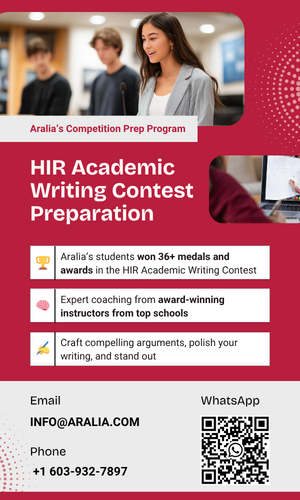
Prepare for the Harvard International Review Academic Writing Contest with an advanced global affairs course designed to help students craft a standout 800–1,200-word academic essay. Through expert instruction, analytical training, and hands-on writing workshops, students develop critical thinking and research skills.