


The Common Data Set (CDS) is a free, standardized report published annually by colleges that provides detailed, reliable information about admissions, academics, student life, and financial aid.
Section C (First-Year Admissions) is especially useful, showing acceptance rates, test score ranges, GPA distributions, and the weightings of different application factors. By comparing their own profile to this data, students can identify strengths and gaps and make more strategic decisions.
1. What Is the Common Data Set?
The Common Data Set (CDS) is a standardized framework of definitions and data items used by colleges and universities to report key institutional information. It is produced annually through a collaborative initiative among the country’s major higher-education data publishers, including the College Board, Peterson’s, and U.S. News & World Report, in partnership with colleges and universities to create a uniform reporting format. The goal of this collaboration is to improve the quality, accuracy, and transparency of information provided to both prospective students and researchers.
The Common Data Set is completely free for any student to access!
85% of Aralia Students Place in Top Writing Competitions
2. What Information Does the Common Data Set Contain?
A Common Data Set spans more than 30 pages, covering ten major standardized sections:
- General Information: Basic information about the college, including institution type, degrees offered, campus locations, and accreditation status, among others
- Enrollment & Persistence: Student population data, degrees awarded, graduation rates, and first-year retention rates.
- First-Time/First-Year Admissions: Statistics on application volumes, acceptance rates, admission requirements, standardized test policies (SAT/ACT), and academic profiles of admitted students.
- Transfer Admission: Documentary requirements, credit evaluation policies, and academic profiles for transfer applicants and students.
- Academic Offerings & Policies: Special study options (honors programs, study abroad opportunities, internships, distance learning options) and required general education coursework.
- Student Life: Information about students’ life on campus, including campus activities, housing types, student clubs/organizations, and ROTC program availability
- Annual Expenses: A full tuition and cost breakdown, including fees, room and board, and estimated personal expenses for the 2026–2027 academic year
- Financial Aid: Types and amounts of aid awarded, number of students receiving aid, average aid packages, and application processes.
- Instructional Faculty: Full-time and part-time faculty counts, faculty demographics, terminal degree attainment, student-to-faculty ratio, and class size distribution.
- Degrees Conferred: Percentage breakdown of degrees awarded by academic discipline
3. Why the CDS Is an Essential Admissions Tool
Because institutions submit CDS data directly to federal databases and major educational publishers using uniform, standardized definitions, it represents the most reliable admissions data available anywhere.
For students and parents navigating the college application process, Section C (First-Time, First-Year Admissions) of the CDS is especially critical, as it reveals:
- Acceptance rates – the total number of applicants, admits, and enrolled students
- Standardized test score ranges (SAT/ACT) – middle 50% SAT and ACT scores for admitted students
- GPA distributions – the academic profile of the admitted class
- Application requirements – what materials each school requires for admission, which typically include school records, essays, and letters of recommendation, among others
- Admission factor weightings – how the school officially rates the importance of grades, essays, recommendations, extracurriculars, character, and more
For example, Harvard University’s 2024-2025 CDS reports that a total of 54,008 students applied, 1,647 were admitted, and 1,647 enrolled in Fall 2024, with the middle 50% of admitted students scoring between 1510 and 1580 on the SAT. Moreover, MIT’s 2024-2025 CDS reveals that 28,232 students applied, 1,284 were admitted, and 1,106 enrolled, with a middle 50% SAT composite range of 1520 to 1570. These numbers are not estimates or journalistic approximations. They are official figures that schools submit to federal and educational publishers, making them the most reliable admissions data available.
4. What’s New in the 2025–2026 CDS?
Each year, the CDS is updated to reflect changes in reporting standards and institutional priorities. The 2025–2026 cycle introduces updated terminology designed to bring the CDS into closer alignment with federal reporting practices, improving clarity and cross-institutional comparability. While these changes do not fundamentally alter how students interpret the CDS, they do shape the CDS into a more standardized and transparent document overall. View the full list of updates here.
Aralia Students Are 4x More Likely to Publish a Research Paper
5. How to Use the Common Data Set in Your College Application Strategy
The most effective approach is to treat the CDS as a benchmarking tool: compare your academic profile against the data for each school on your list, identify your relative strengths and weaknesses, and tailor your application strategy accordingly.
To find any university’s CDS, simply search: Common Data Set by searching: [school name] Common Data Set. The latest data available is the 2024-2025 dataset.
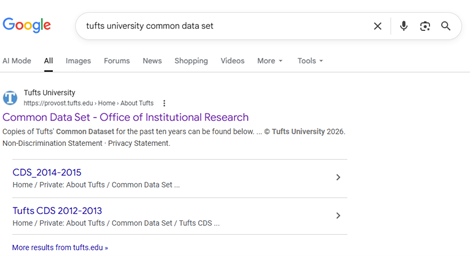
To see how the Common Data Set can guide real decisions, consider an example student applying to Tufts University and reflect on your own application strategy.
Student Profile:
- GPA: 3.8 (unweighted), with rigorous course load (AP/IB classes)
- SAT: 1420
- Activities: Debate team captain, volunteer tutor, summer research program
- Intended major: Political Science / International Relations
At first glance, the student’s profile appears competitive. But Tufts’ Common Data Set provides a more precise lens for evaluation. Let’s take a look at the “First-Time, First-Year (Freshman) Admission” section to compare the student’s academic credentials against the average admitted student.
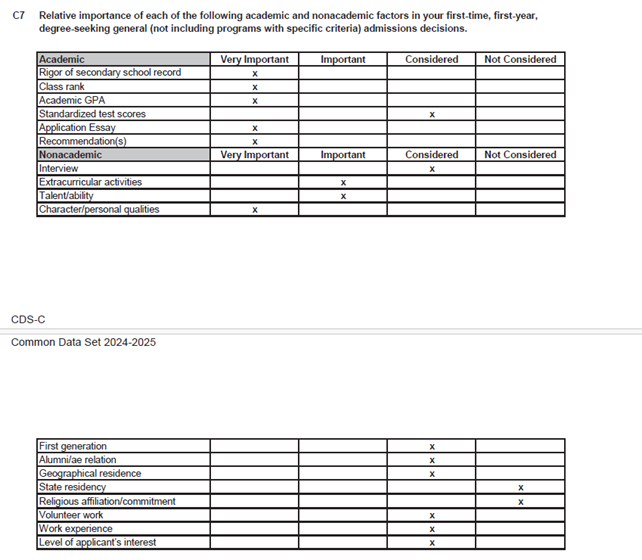
Comparing the student’s profile with the school’s CDS, the profile is strong in areas Tufts values most (rigorous academics, GPA, character, extracurriculars). The student’s intended major (Political Science/International Relations) also aligns well with demonstrated leadership and civic engagement.
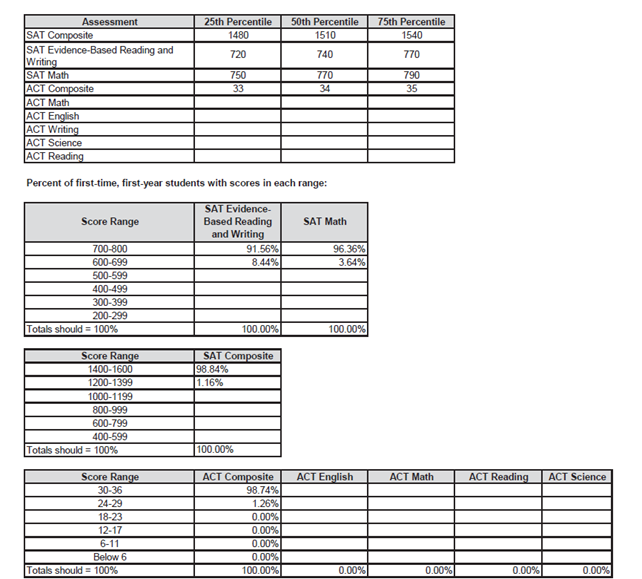
The student’s test score is a weakness for Tufts, as 1420 falls below the 25th percentile at Tufts. However, Tufts marks standardized tests as “Considered” (not “Very Important” or “Important”). The school rates the rigor of coursework, GPA, character/personal qualities, and extracurricular activities as more important. This means that the student’s strong academic record (3.8 GPA, rigorous courses), leadership activities, and character qualities may help partially offset the gap in standardized test scores.
This student’s 3.8 GPA and demanding course load directly address what Tufts values most. Her debate captaincy, civic engagement through tutoring, and academic research experience align exceptionally well with a Political Science/International Relations candidacy. The test score gap is real, but it is not disqualifying at an institution that prioritizes holistic factors over standardized testing. The application’s success will likely hinge on the quality of her essays, the strength of her recommendations, and how compellingly she articulates her intellectual interests and future goals in the interview.
For more tips on how to stand out during the college admissions process, check out these additional resources:
6. Aralia’s College Application Essay Writing Program
One thing becomes clear when you study the Common Data Sets of enough selective institutions: the application essay is always important. Across virtually every competitive institution, this requirement is rated among the most significant admissions factors, often above test scores and sometimes on par with GPA.
A compelling, authentic essay is what makes an admissions officer remember you. However, we recognize that writing a great college essay is difficult, as it requires not only sophisticated writing skills but also self-reflection and a deep understanding of what each school is looking for.
That’s exactly why Aralia Education has developed its College Application Essay Writing Program, a specialized program designed to help students craft application essays that stand out. For students who need guidance in this process, Aralia is well equipped with tools and experienced professionals ready to transform your experiences into a narrative that will truly impress admissions committees.
Explore Aralia’s College Application Essay Writing Program and take the first step toward a successful college application.