


The National Latin Exam spans multiple proficiency levels, from introductory coursework to advanced literary Latin, and has become one of the most widely recognized academic competitions in classical studies.
This article breaks down the 2026 results to show which parts of the exam students find hardest. We will look at award rates across proficiency levels and the specific skills, particularly grammar, that separate strong scorers from the rest.
1. How Many Students Participate in the National Latin Exam?
Data from the 49th annual administration of the NLE highlights the relevance of classical studies within modern education. During the testing window from late February to early March 2026, 93,159 students completed the exam out of 101,301 registered participants. That puts the attendance rate at roughly 92%, a fairly strong completion rate for a voluntary academic exam, suggesting strong commitment once students register.
While the primary cohort resides within the United States, its reach extends well beyond the country’s borders. In the recently concluded exam, students from all 50 states and the District of Columbia participated alongside peers from 26 additional countries, including:
- Canada
- China
- Italy
- Japan
- South Korea
- Singapore
- Taiwan
- United Kingdom
While international test-takers accounted for only 2.3% of the total testing population, the exam’s global presence demonstrates the continued interest in Latin education worldwide. Notable entries from emerging regions such as Myanmar, Kazakhstan, and Kenya indicate that Latin instruction extends well beyond traditional international-school hubs, likely through schools that follow American or British curricula abroad.
Within the United States, total participation remains concentrated in a core group of states. Texas, New York, and Massachusetts form a tight leading cluster, each contributing more than 7000 students. Massachusetts’s presence in the top 3 is demographically notable, given its much smaller population compared to Texas or New York. But the most interesting trend is where participation is growing fastest, indicating that the exam’s geographic distribution is shifting due to rapid regional growth. The highest year-over-year increases occurred in non-traditional regions:
State | Year-over-Year Growth Rate |
Nevada | 41% |
Iowa | 36% |
Alabama | 26% |
Arkansas | 26% |
These states still contribute fewer total students than traditional Latin strongholds, but the pace of growth suggests that Latin education is taking root in regions where it has historically been less prominent.
Taken together, these participation trends suggest that the National Latin Exam continues to evolve and no longer looks like a competition confined to a small number of elite schools. Each year, it is reaching a broader and more geographically diverse student population, reinforcing its standing as one of the most significant academic competitions in classical studies.
Master Latin with Expert Guidance
2. What Awards Can Students Earn on the National Latin Exam?
Before looking at how many students earn recognition, it is important to understand the NLE’s award system. The National Latin Exam awards students based on their scores. This allows students at different stages of Latin study to earn recognition for strong performance.
The NLE offers several levels of recognition, ranging from certificates for strong achievement to medals and special awards for the highest-performing students.
- Perfect Paper (Highest Achievement): is given to students who answer every question on the exam correctly.
- Medal Awards: Students with the highest scores receive medals alongside their certificates. These awards recognize the top performers nationally within each exam level. The medal hierarchy is: Gold Medal, Silver Medal, Magna Cum Laude Certificate, and Cum Laude Certificate.
- Special Book Awards for Long-Term Achievement: Beyond annual exam recognition, the NLE also honors students who demonstrate sustained excellence over multiple years.
To qualify for these special awards, students must complete at least one Advanced Level exam. Since Advanced Level exams represent the highest level of NLE testing, repeated success at this stage demonstrates long-term commitment and advanced Latin ability.
3. What Percentage of Students Earn Awards?
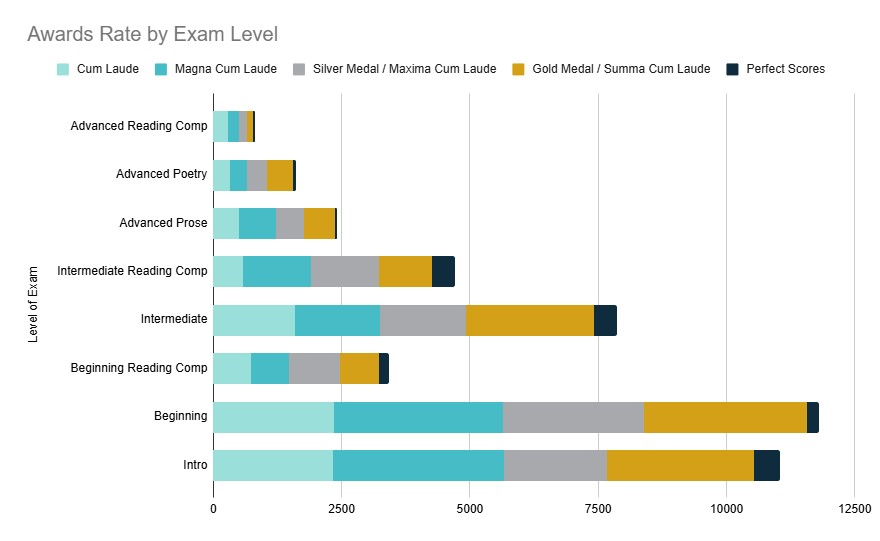
Overall, 44.7% of participants received an award, with award rates remaining remarkably consistent across every exam level, ranging from approximately 40% to 47%.
Awards are generously given to students who score above the national average for their exam level, indicating that NLE recognizes strong performance at every stage of Latin study rather than reserving recognition for a small pool of top scorers.
Recognition Remains Consistent Across Different Exam Levels
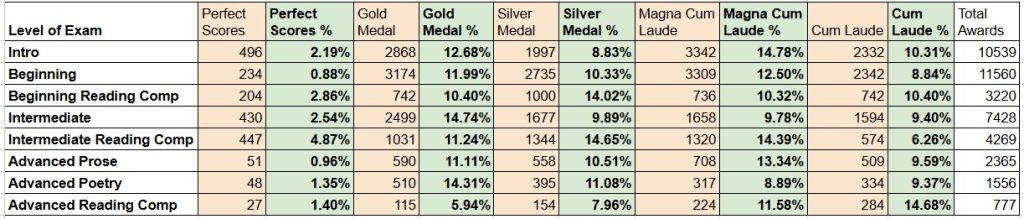
Gold Medal rates were relatively consistent, generally ranging from 10–15%. For example, Intermediate Latin had the highest Gold Medal rate at 14.7%, followed closely by Advanced Poetry at 14.3% and Introduction to Latin at 12.7%. However, Advanced Reading Comprehension stood out with only 5.9% of students earning Gold Medals, suggesting that this highest-level exam presents a greater challenge even within the NLE’s level-based scoring system.
Silver Medal (Maxima Cum Laude) and Magna Cum Laude awards followed a similar pattern across most exam levels, typically recognizing around 9–15% of participants.
Cum Laude awards were distributed more evenly across most exams, generally ranging between 8–10% of participants. The exception was Advanced Reading Comprehension, where 14.7% of students earned Cum Laude recognition, the highest Cum Laude rate across all levels.
The consistency across most levels highlights the NLE’s balanced approach: students studying Latin at different stages have comparable opportunities to earn recognition, while the most advanced exams still maintain a higher barrier for top achievement.
Few Students Reached the Highest Level of Recognition
While nearly half of NLE participants earned some form of recognition, the highest awards remained much more difficult to achieve. Among all 93,159 participants in the 2026 cycle, only a small percentage reached the top tiers of recognition.
| Award Level | Number of Students | Percentage of Participants |
|---|---|---|
| Gold Medal (Summa Cum Laude) | 11,529 | 12.4% |
| Silver Medal (Maxima Cum Laude) | 9,860 | 10.6% |
| Magna Cum Laude | 11,614 | 12.5% |
| Cum Laude | 8,711 | 9.3% |
Gold Medal recipients represented approximately 1 in 8 participants, making it the highest and most selective standard award category. However, the difference between Gold, Silver, and Magna Cum Laude recognition is relatively narrow, reflecting the NLE’s goal of recognizing strong performance across different levels of Latin study rather than only a small group of elite scorers.
Perfect Scores Are Exceptionally Rare
Although nearly 45% of participants earned an award, only 1,937 students, approximately 2.1% of all test takers, answered every question correctly.
| Award Level | Number of Students | Percentage of Participants |
|---|---|---|
| Perfect Score | 1,937 | 2.1% |
This large gap between award recipients and perfect scorers suggests that the National Latin Exam is designed to reward mastery without requiring perfection for top honors. Having said this, a student can demonstrate excellent command of Latin and receive a top award even if they miss a handful of the exam’s toughest items.
4. Which Parts of the National Latin Exam Are the Most Difficult?
The 2026 test evaluates students across four major areas: Latin grammar, reading comprehension, Roman history and culture, and classical mythology. As students progress through higher exam levels, the requirement gradually shifts from simply recognizing words to interpreting increasingly sophisticated Latin syntax.
Grammar Is the Greatest Challenge
Whether students are taking Beginning Latin or Advanced Latin Prose, the most difficult questions almost always require them to analyze sentence structure rather than simply translate individual words. On the National Latin Exam, vocabulary questions can often be solved through direct memorization, but grammar questions demand logical analysis. The most difficult items consistently feature advanced syntax, including:
- Purpose clauses
- Participles and absolute constructions
- Relative clauses
- Complex uses of the ablative case
To understand why students struggle with these specific areas, it helps to look at how Latin operates compared to English:
- English relies heavily on word order: the sentence structure usually follows a strict Subject-Verb-Object pattern. If you change the order of the words (“The dog bit the man” versus “The man bit the dog”), you change the entire meaning of the sentence.
- Latin is an inflected language, meaning it relies heavily on word endings (cases) rather than the sequence of words. A writer can place the subject at the very end of the sentence, and the object at the very beginning, and the actual meaning remains unchanged because the endings tell you who is doing what.
Vocabulary Is Easier
By contrast, the 2026 NLE revealed that the easiest questions to answer are those that involve vocabulary or direct sentence comprehension.
For example, Introduction-level participants correctly identified the conjunction et (“and”) at a rate of 94%. Similarly, Intermediate cohort participants answered a basic vocabulary question about minima arbor (“very small tree”) correctly with a rate exceeding 90%.
These metrics indicate that students generally develop a solid vocabulary foundation early in their Latin studies. However, vocabulary knowledge alone is insufficient for high performance once grammar becomes more sophisticated. The reason is that vocabulary tends to be learned through repetition and direct exposure, which makes it easier to retain. Grammar, on the other hand, requires students to learn rules and apply them flexibly across unfamiliar sentence structures, a skill that takes longer to develop and is harder to test through simple recall.
Interestingly, cultural familiarity does not always guarantee success. For example, 57% of Introduction students correctly interpreted the well-known phrase carpe diem. This suggests that even famous Latin expressions can be harder to grasp when presented in a multiple-choice format with tricky distractors.
Historical and Cultural Knowledge Varies by Familiarity
Questions about Roman history, mythology, and classical civilization show much greater variation in difficulty than grammar questions.
Students generally performed well on widely taught topics or familiar cultural references, such as gladiators or Roman agriculture. However, more specialized historical knowledge proved significantly harder.
For example, many Advanced Latin students struggled to identify Tacitus as the author of the historical books Annales and Germania, and fewer than half knew that Emperor Claudius was allegedly poisoned by his wife, Agrippina.
Unlike grammar questions, which are consistently difficult across all levels, history and culture questions only become challenging when they demand specific detail rather than general awareness.
85% of Aralia Students Receive Awards in Top Classics Competitions
5. How the Exam Evolves As Students Advance
The clearest pattern across the 2026 results is the progression of questions as participants advance.
- Introduction and Beginning Latin emphasize foundational vocabulary, basic grammar, and introductory Roman culture.
- Intermediate Latin focuses more on complex grammatical analysis, such as sentence structure, and requires broader knowledge of mythology and Roman civilization.
- Advanced Latin Prose and Poetry asks students to read and interpret authentic Latin literature, in which they must understand sophisticated syntax and connect literary passages to historical and cultural context.
Students are increasingly asked to move beyond memorizing facts and apply more critical thinking. This can take the form of explaining why a grammatical construction functions in a certain way and of inferring meaning from context.
The 2026 item analysis makes a clear case: the National Latin Exam rewards depth of understanding over memorization. A strong set of vocabulary lists or historical facts can carry a student through many introductory questions successfully, but they lose value quickly at higher levels. The highest scores rely heavily on mastery of Latin grammar and strong reading skills. As students advance through the exam levels, success increasingly comes down to understanding how Latin technically functions as a language, not simply what individual words mean.
This progression explains why grammar remains the hardest part of the exam and why perfect scores remain exceptionally rare despite nearly half of the participants earning an award.
Take Aralia’s Latin Mastery Pathway Program
For students preparing for the National Latin Exam, the 2026 results serve as a practical lesson: a strong vocabulary and solid cultural knowledge lay the groundwork, but long-term success comes down to a deep understanding of Latin grammar. Students who invest time in mastering grammatical structures through regular reading and translation practice will be better prepared not only to earn awards but also to obtain the highest distinctions.
Aralia Education’s Latin Mastery Pathway Program is designed with this progression in mind. Backed by instructors experienced in classical language pedagogy, it features a six-level curriculum designed to help students build lasting proficiency in Latin through systematic instruction in grammar, vocabulary, translation, reading comprehension, and classical civilization. As students advance, they gain the analytical skills needed to interpret increasingly complex Latin texts, which are the same skills assessed on the National Latin Exam, the National Latin Vocabulary Exam, the National Roman Civilization Exam, and the AP Latin Exam.